Foster2Forever

  • Home
  • Shop
  • Fostering & Adoption
    • Foster Care
      • Being a Foster Home
      • Birthfamilies
      • Case Workers
      • Concerns
      • Court Hearings
    • Adoption
      • Parenting Tips for After Adoption
      • Benefits
      • Costs
      • Infertility
      • Parental Rights
  • Parenting
    • 31 Tips for Parenting After Adoption
    • Behavior Issues
    • Children’s Activities
    • Family Time
    • Motherhood
  • Our Home Life
    • Cancer & Health
    • Recipes
    • Marriage
    • Family Travel
    • Videos
  • Join Our Community
  • Our Family
  • Contact
  • Privacy Policy

9:00 am by Penelope

What is Your Child Afraid Of? 6 Tips for Overcoming a Child’s Fear

“Come watch me!”

The 5-year-old had an incredible fear of being alone – to the point where he wanted me to watch him poop. He wouldn’t let me be in the next room. I had to be right there – watching (and smelling). And if I didn’t respond immediately, he would throw a fit!

This would get annoying – He was in Kindergarten – 5-year-olds can go to the bathroom by themselves at this age!

But then I remember his history: Brought to us at 8-months-old. Very ill and congested. A diaper rash the size of the diaper. Unable to even roll over. And screaming if I left his sight or if a door was simply closed in the room. (My baby was seriously neglected, constantly being left in a car seat in another room by himself during drug binges.)

I have been reading The Connected Child: Bring hope and healing to your adoptive family.

I’m now on Chapter 4 (“Disarming the Fear Response with Felt Safety”) which details the many ways to help a child feel safe.  This chapter had an overwhelming number of tips and techniques on creating an environment of “felt safety” especially in regard to schedules and avoiding tantrums – the best chapter so far.
overcoming-childhood-fears

As far as a child’s fear of being alone, I found these:

6 Tips to Overcome Fear in Children

  1. Be approachable – Getting down and talking at a child’s level can help build trust so that a child can share what’s really going on with them
  2. Honor your child’s emotions – As tempting as it is, a parent should never tell a child that “A Kindergartner should go to the bathroom without Mommy having to watch.”  A child has a fear that a parent should acknowledge.
  3. Be responsive to your child’s need for assurance – Always send the message to your child that you understand how he feels and that he is safe.
  4. Give choices – This helps a child feel empowered with their situation. “Do you want stand or sit when you potty?“
  5. Help your child through the challenge of overcoming his fear – I went to the bathroom with this child for months.  I would challenge him by standing by the doorway to the bathroom where he could see my arm. One day, he just went to the bathroom alone because he knew I was in the next room. Yeah!
  6. Praise accomplishment – “Wow! Look at you! I stood outside with my arm in the door! You are getting so big!“

What is your child afraid of? How do you help your child overcome their fears?

9:00 am by Penelope

Why This Meltdown? Identifying Emotional Triggers

Does your child randomly throw a tantrum for no reason? There could possibly be big reason for the tantrum…

trauma-triggers-tantrums

For those of you who follow on Facebook, Instagram, or Twitter, you may have read this update–

What was the trigger for this emotional outburst?

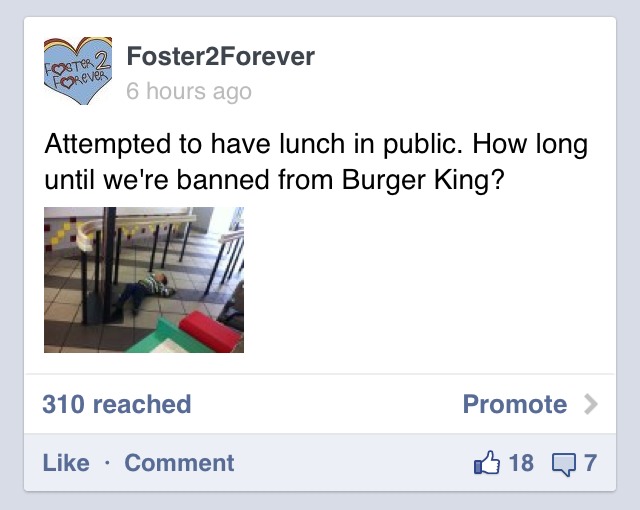
The 5-year-old who had been diagnosed with Reactive Attachment Disorder, had had a GREAT morning! We rewarded him with choosing where we would have lunch after church. He decided he wanted to have lunch at “Bo King” – Great!  Hubs ordered our lunch when the child decided he wanted some Cinnabon rolls.

FosterDad’s reply: “After you finish lunch.”

And then the tantrum started! There was not a “NO” said to the little tyke. But, regardless, he fell to the floor immediately, in full-tantrum mode.

Anything we said to him, only agitated him more. So we left him there. In the order line at Burger King.  With other customers stepping over him.

Anytime I went to check on him, it only inflamed him more – to the point where he was kicking the display signs. So I left him there.

The rest of the family was in the play area eating. Then after a few minutes, he began peeking to see what we were doing. Eating. That’s what we were doing. Not paying attention to him.

Then he stands up, one hand on the napkin dispenser, daring me to notice him, so he could pull out all the napkins and throw them on the floor.  I moved to where he couldn’t see me.

A few minutes later, he peeked into the play area.  My response:

“Oh boy, you look hungry! Is my little boy hungry?”

He then hopped into my lap and enthusiastically ate his lunch!!! MY SON WAS HUNGRY!!! (Low blood sugar can trigger the fear response in a neglected child)

I did acknowledge his poor behavior by discussing it while rubbing his back. “Does throwing a fit get your way? No? Let’s try harder next time!”

Afterward we had the best Sunday afternoon at home as a family in a month!

I’m currently reading The Connected Child: Bring hope and healing to your adoptive family (are you reading along with me?).

I’m now on Chapter 3 (“Solving the Puzzle of Difficult Behavior”) which discusses how a child’s emotional trauma and difficult background can trigger difficult behaviors in everyday situations.

The Takeaways About Emotional Triggers:

  • Keep a journal of your child’s daily activities and behaviors to try to decipher the emotional triggers
  • Learn everything you can about a child’s background and trauma, i.e. sexual abuse, prenatal drug or alcohol exposure, neglect
  • Watch for patterns (i.e. transitioning from one activity to the next)
  • Be alert to any triggers that may cause your child to lose control of their emotions.

Read the shocking truth about how I discovered the trigger behind this child’s outbursts.

9:00 am by Penelope

I’m Treating my Kindergartner Like a Baby – And It’s Working

For those of you with children that may have Reactive Attachment Disorder (RAD) or other attachment issues, you can understand the disruption it causes in your family. The sheer exhaustion of it all.

Many times I am overwhelmed by the reaction that my child has sometimes. And nothing seems to work. However, after so many of you recommended it, I finally began reading The Connected Child: Bring hope and healing to your adoptive familyby Dr. Karyn Purvis of TCU.  (Read about Feeling Hopeless from Chapter 1. Are you reading along?)

Chapter 2 of The Connected Child is “Where Your Child Began” and describes all the sensory input your adopted child may have missed to be able to form normal attachments in life. Chapter 2 of the companion study guide, Created to Connect, focuses on feeling compassion for your child.  I do feel compassion for my child – I love him – but sometimes when he turns into possessed devil-child, I just want to lay down the strict law to get his little butt to straighten up!

However, there was one small sentence in the book that hit me: “Your job, as parents, is to help these children get what they missed…” Then the study guide expanded on this concept about “Returning to the Beginning” discussing how children may actually be required to “go backwards” in order to move forward. When I read the illustration about the older adoptee wanting hot tea with her mom many times a day and her mom’s comparison to bottles and sippy cups, it struck a chord with me.

Although we received our child as an 8-month-old foster baby, do we need to somehow go backward and makeup for those first 8 months of neglect?

One night, our child had another horrible episode. He wanted to go outside and play football but was refusing to eat supper. He even attempted to throw his plate across the room. FosterDad was clearly in discipline mode.  I intervened with another approach.

reactive-attachment-disorder-therapy

As I scooped my little one up in my lap, he first fought me, but in a soft baby-toned voice, I began saying: “Oh! My little baby needs to eat supper, but this food is for big kids. Let’s mash this up and put a bib on this baby! Oh, here’s a bite. Open wide, baby…”

Would you believe, he began playing like he was a baby and anxiously took bite after bite until he was done?  Then he got down and went outside to throw the football with Daddy.

Whoa! Crazy, huh? But it worked!

Then the next night again, he was throwing a fit about wanting some candy, but we had Pediasure for him to drink. I picked up the squirt bottle it was in, acting like it was a bottle, and put my child in my lap in the rocking chair. “Oh, look at this baby needing his bottle!”  He drank it quickly and the evening went well after all that drama.

This is nuts! But it’s working!

Now, I don’t want my child ruling the roost, so to speak, but by “going backwards”, he is getting something that he missed, and we, as parents, are getting him to mind (in a weird kind of way).  Is this approach the right approach?  Who knows?

There will be someone that will criticize me for “giving in” to his fits, but it’s working right now for our family right now.

Hopefully, I won’t be picking him up and treating him like a baby when he’s a teenager – THAT would be awkward!

Are you reading The Connected Child along with me? What may your child have missed? How can you go backwards to help heal your child?

9:00 am by Penelope

Why Back to School Frightens Me

It’s time for BACK TO SCHOOL!!!  And I am anxious – more than a child, I believe. You see, our strong-willed RADish begins Kindergarten soon.

Back to School time is probably not a big deal to most moms – except that sadness to see your little baby walking into big school for the first time.

But this year, for me, Back to School time brings on anxiety and worry about how my little boy (with emotional needs that are tough to understand) is going to handle the pressures of school.

He was kicked out of three day cares for behavior issues. (Yes – Three!!!)  Last year, when he was kicked out of the third day care, we enrolled him in half-day Pre-K while FosterDad and I took turns using FMLA to care for him.

School for only half the day was a good thing for him. He still had a few bad days, but for the most part, a good transition for him. When asked how was school that day, he would reply:

“No time out. No trip to the principal’s office. It was a Good Day!“

However, our child is enrolled in full-day Kindergarten for this upcoming school year.

Lately, especially after having 3 foster children in our home for a few weeks, he has been regressing. Last weekend, for FosterDad’s birthday, we attempted overnight respite. He raged for HOURS after I left him with the caregiver. (He won’t be going back there!)

Is our child ready for BACK TO SCHOOL?

I don’t know! But our backup plan is that if our child isn’t ready for full-day Kindergarten — he can just repeat Pre-K!

Pros:

  • He just turned 5 so a late birthday won’t matter much – He is currently at the 5th percentile for height & hopefully wouldn’t be the smallest in the class
  • He knows the teachers and the teachers know him
  • FosterDad is now retired so he can care for our son half the day

Cons:

  • He is bright so repeating will bore him –
  • With a late birthday for a small boy obsessed with sports, we want hold him back one year but hoping it would be Kindergarten where he would have a stronger curriculum.

We are praying that our child adjusts well this school year.

What are your fears or anxieties about Back to School?

UPDATE: My son had a fabulous year with only one incidence of misbehavior!!!

8:12 am by Penelope

Healing from the Grief of a Failed Adoption

Today we have special guest, Annette from Fried Green Tomatoes and Sweet Tea sharing her touching story with you…
My story is different than many, in that my husband and I did not decide to Foster but rather we were asked by a teenage mother to adopt her baby that she was unable to care for. We were told that her biological father had nothing to do with her, and her mother told us that she just could not handle being a mother.  “Sweet Pea” was turned over to Department of Social Services (DSS) one weekend and placed in a temporary Foster Home. When her mother met with Attorneys the following Monday. she named us as Guardianship Caregivers (and future adoptive parents). After meeting with DSS and having a home inspection, we signed up for fostering classes and brought Sweet Pea home with us.
The goal of DSS is reunification and we always knew that. but the biological mother (who called me often) was adamant that the father was going to sign the adoption papers. He didn’t! He decided he wanted custody of Sweet Pea and visitations were given. I always dressed her up and sent notes to him about what she was doing that was new (like when she rolled over for the first time).  Eventually full custody was given to Sweet Pea’s father, with a few stipulations, such as taking parenting classes.
We bonded with Sweet Pea, and I had convinced myself she would be ours and her Daddy would not fulfill his part, but he did. After three months, we were told that we had to hand her over to her daddy. I wrote about that day here on my blog.
Losing our foster baby was the hardest thing that I have ever done! It hurt and I’ve cried a river of tears over the past year but I would not change a thing. That baby girl needed a mother figure to care for her and give her stability. I gave her that. She was loved by my three daughters and my husband. We were given the opportunity to talk with her Daddy and give him some advice that parents often give since he didn’t have that kind of family support. As difficult as it was, I can now look back and see that we were there for Sweet Pea and we were there for her mother and her father. We showed them the love of Christ at a difficult time.
Fostering is a blessing for all involved. It’s the most difficult thing I’ve ever done but who could walk away from a child in need. The loss of that baby girl was like a death to me, and the healing took a long time. It’s been a year now, and I can finally smile when I see her pictures instead of cry.  Healing takes time but it happens, and I am thankful for the opportunity to be a part of that family’s life during a difficult time.

Has your heart been broken by a failed adoption?

Annette Smith is the wife of a cop and a mother to four children (ages 11,16,18,20) and chickens. She has been married for 23 years. She’s addicted to blogging about her live in the South at Fried Green Tomatoes and Sweet Tea.

7:56 am by Penelope

My Struggle with Attachment Disorder

toddler-tantrum-foster-child-trauma-bonding-attachmentHe was out-of control – as if demons had taken over his soul. His screaming was unintelligible. His body was flailing about with his arms punching the air or anything in the way. His face was the color of a sun-ripened tomato. His kicking jerked as his body contorted into different directions.

This wasn’t just a tantrum.

My role as a mother is to raise my precious preschooler into a Godly man. But my doubts overwhelm me during these moments. Had Satan already taken hostage of my child through a disorder known as Reactive Attachment Disorder or RAD?

In these moments, I am broken. I fall to my knees crying out for God to release the demon from my beloved child.

Through the prayers, God is awakening me to devote myself to this child.

Whatever it takes, dear Lord!

My child has emotions from his neglected infanthood that he cannot understand or control. His desire is to have all his physical needs met and feel that unconditional love.

As his mother, I have to make sacrifices. I’ve taken him out of full-day school. I’ve taken family leave from work to demonstrate to him that Mommy loves him and wants to be with him.

I devote my life to my son.

A problem that isn’t too large for my Lord and Savior.

Have you liked Foster2Forever’s Facebook page?

9:00 am by Penelope

Why Does My Child Act Like This? Could It Be RAD?

We began our foster care journey in the early 80s, and in 1985, we adopted a six-month-old baby girl from foster care, with known exposure to alcohol in utero. She smiled from the moment I saw her. She liked almost everyone at first meeting, and brought them books to read and toys to play with. She climbed into every willing lap she saw. She wasn’t much on cuddling, but as my mother said, “some kids are, some kids aren’t”. Although I didn’t know it then, I had just adopted my first child with Reactive Attachment Disorder (RAD) and FASD (Fetal Alcohol Spectrum Disorder).

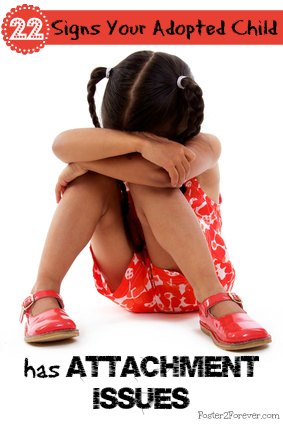
rad-signs-in-children

Types of Attachment

Attachment between a mother and her child is the bond formed between them, and the foundation of all future development. The ideal bond is a Secure Attachment.

An Insecure Attachment occurs when something interferes with the bonding between the mother and child, such as in utero alcohol or drug use, physical abuse, or extreme stress experienced by the mother. Early neglect, physical abuse, sexual abuse, prolonged separation, major illness, or multiple changes in caregivers in a child’s early years can also interfere with a healthy attachment.

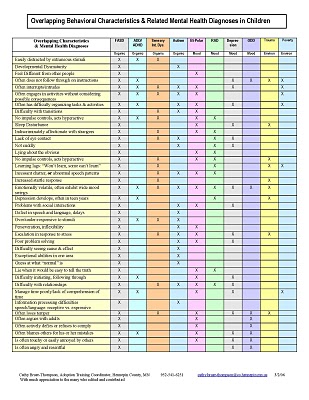
Attachment disorders come in degrees of severity, with the most severe being Reactive Attachment Disorder. Very few children, even those with RAD, have all of the following symptoms. Since a number of the major psychiatric disorders have overlapping symptoms, you should take any child you are concerned about for a full evaluation by a competent psychiatrist.

Overlapping Behavioral Characteristics – Click on the image to see full chart

 Symptoms of Reactive Attachment Disorder

• Superficially engaging & charming • Lack of eye contact on parents terms • Indiscriminately affectionate with strangers • Not affectionate on Parents’ terms (not cuddly) • Destructive to self, others and material things (accident prone) • Cruelty to animals • Lying about the obvious (crazy lying) • Stealing • No impulse controls (frequently acts hyperactive) • Learning Lags • Lack of cause and effect thinking • Lack of conscience • Abnormal eating patterns • Poor peer relationships • Preoccupation with fire • Preoccupation with blood & gore • Persistent nonsense questions & chatter • Inappropriately demanding & clingy • Abnormal speech patterns • Triangulation of adults • False allegations of abuse • Presumptive entitlement issues

Treatment of RAD

Children with attachment disorders who do not receive appropriate interventions frequently develop personality disorders as adults. RAD is the most severe attachment disorder and has the poorest outcome, especially if left untreated.

The younger the child, the less symptoms you are likely to see. We adopted a 4 ¾ year old in August 2010, from a disruption. She is now 6 ½ and diagnosed with RAD. The only two symptoms she doesn’t currently display are preoccupation with fire and preoccupation with blood and gore.

She attends a day treatment program held in one of the local elementary schools. She has therapy three times a week, sees the psychiatrist every two weeks. We recently were approved for waiver services, which gives us 24/7 crisis support, skill-building programs, and respite care.

We encourage eye contact with chocolate, incorporate as much good touch into play as possible, and refuse to allow her to sabotage the big family holidays with her behavior. We are even taking her on a cruise this summer with us, although a friend who is trained in providing respite is coming with us. We are currently looking for an attachment therapist, preferably trained by Dan Hughes in Attachment-Focused Family Therapy.

A child with RAD needs intensive support to heal. We have recently began implementing the “Parenting in SPACE” through Safety, Support, Supervision, Structure, Playfulness, Acceptance, Curiosity and Empathy. We feel that this paradigm gives us the best chance to help our RAD daughter heal. Providing safety, support, supervision, and structure are mandatory. Playfulness, acceptance, curiosity, and empathy are the things that differentiate a family from an institution.

Raising a child with RAD isn’t easy; however, as we see progress in our daughter, we find the rewards.
You can read more about attachment parenting in these books:
Attachment-Focused Parenting: Effective Strategies to Care for Children ,
When Love Is Not Enough: A Guide to Parenting Children with RAD,
The Connected Child : Bring Hope and Healing to Your Adoptive Family, or
Easy to Love but Hard to Raise: Real Parents, Challenging Kids, True Stories.

GBsMom is 55 years old and working on a PhD in Educational Psychology. She has been an adoptive and foster mother for over 30 years. Most of her kids have been some combination of Bipolar, FASD, RAD, ADHD. She has been married for 35 years and is raising her second family, GB, 9, and Hope, 6. She blogs about her life at Adopting Special Needs.

9:00 am by Penelope

Does Adoption Cure Infertility?

As an advocate for foster care and adoption, I wish I could say that we began this journey out of the goodness of our hearts, that we felt compassion for the children who could not be with their original family, and that we desperately wanted to provide a home to those in need.  I wish we could say that we have always wanted to be foster and adoptive parents, but that is not our story.  We are infertile.  It was only after struggling through an uncorrectable, secondary infertility diagnosis that we even considered foster care and even that was only in hopes of adopting.  Yes we loved children and sure we thought it was important that someone take care of them, but we had never stopped to think that that someone might be us.

Foster-to-adopt is one of the many family building options thrown at infertile couples.  We hear things like “why don’t you just adopt” (as if it were that easy) or “there are children out there who will be lucky to have you as parents”.  Most infertile, foster/adopt parents have been lucky enough to hear the infamous “adopt and you’ll get pregnant” line.  These things are said by well-meaning individuals who are just trying to be supportive, but the truth of the matter is that infertility is not fixed by adoption.

infertility-foster-adopt

I may be isolating both the infertility and the adoption community with this one, but it’s true – adoption does not cure infertility.  Adoption and/or foster care may very well be the best option for you.  My husband and I believe strongly that more people could and should foster/adopt and we can attest to the unbelievable joy we’ve received from traveling this road.  I will continue to encourage people, infertile or not, to consider their role in foster care because there are children out there who need good homes and most of us could provide that.  You can make a difference.  There are children out there without a home, without parents.  You should strongly consider it.

Your infertility won’t go away.

We’ve known about our fertility challenges for 5 years and have been foster parents for 2.  I don’t think about infertility often – I no longer think about ovulation or calculate potential due dates on a regular basis.  Frankly, with 4 preschoolers I don’t have time to worry about it.  I am a grateful parent now.  I have had the wonderful opportunity to parent 11 children – I have had sons and daughters in several different combinations with different personalities.  My biological son now has a forever sister – one who won’t go away.  I love them all so much.  But I still desire to be pregnant again.  I still desire to have more biological children.  Even with 4 kiddos I still wonder what it would be like to add another one to the mix and I wish I could just make the decision to get pregnant, like so many others do easily.  When I go to a baby shower or hear another announcement it still stings a little.  The pain has faded and I’m distracted by caring for my family, but I’m still infertile.  People need to know that.  We can’t expect people struggling with infertility to adopt or become foster parents or even conceive through treatment to just move on and never think about infertility and the scars it causes.  This week is National Infertility Awareness Week – consider reaching out to someone you know who has gone through infertility and acknowledge their journey, even if you think they’ve come to terms with their situation.  It’s good to know you’re not ignored.

I wouldn’t trade our experience as foster/adopt parents for fertility – ever.  

Learn the facts about infertility.

What’s your hesitation to opening your home to foster children? Join this great conversation on Facebook!


Foster-momMarie (a.k.a Mie) is primary blogger at LettingGoOfMie where she writes about her journey through life as a wife, mama, foster mama, employee in corporate America, and Ph.D. student. She’s given birth to a boy, adopted a girl, and along with her husband has fostered 9 other children in 2 years. Life has taught her that it can be more than ever imagined, if she’d only learn to let go of herself and trust her Creator…

6:50 am by Penelope

Love From a Birthmother

I’ve begun receiving hate mail. Yes, it’s true. In my naivety, I didn’t think that raising abused and neglected children would be something anyone could hate. However, a community of birthmothers, angry at the foster care system, have attempted on numerous occasions to lash out at me and other foster parents for our role in the system. Although sometimes shocked by their harsh words, I do realize that they are hurting. I pray for healing for these birthfamilies.

However, not all birthfamilies despise foster families.

Some birthfamilies are grateful for the care foster parents give their children. I recently received this comment from a birthmother:

I would like to know how to let my kids’ foster family know how much they mean to me and that they will always be family to me and my kids. They have been with them for 2 years and they are now coming home. These people have been wonderful to me, my kids and my new baby.  Without them, none of this (reunification) would be able to happen.

I was really close with them until we got the news the kids would be coming home . I am sure they are crushed. I just want them to know they will always be Mama H and Daddy S to the kids as well as their kids’ brother and sister.

Can anyone tell me the best way to go about this please?

My reply was: “a simple card with a letter stating how you feel should help them through the healing process.”

What are your thoughts?  How can a birthmother show love and appreciation to foster parents?

photoshop-elements-black-and-white-action-coffeeshop-mocha-velvet-free

Hugs & Kisses at IHeartFaces.com - Click for free PhotoShop action

  • « Previous Page
  • 1
  • 2
  • 3
  • 4
  • 5
  • 6
  • Next Page »

Looking for something?

Facebook

Foster2Forever

Archives

Why Every Foster Parent Needs Sexual Abuse Training

foster care visitation rules guidelines online

10 Tips for Foster Care Visitation Online

foster-income-taxable

Is Foster Income Taxable? What Foster Parents Should Know About Income Tax

Why Every Foster Parent Needs Sexual Abuse Training

I’m Clever

Sway

Pretty Chic Theme By: Pretty Darn Cute Design