Foster2Forever

  • Home
  • Shop
  • Fostering & Adoption
    • Foster Care
      • Being a Foster Home
      • Birthfamilies
      • Case Workers
      • Concerns
      • Court Hearings
    • Adoption
      • Parenting Tips for After Adoption
      • Benefits
      • Costs
      • Infertility
      • Parental Rights
  • Parenting
    • 31 Tips for Parenting After Adoption
    • Behavior Issues
    • Children’s Activities
    • Family Time
    • Motherhood
  • Our Home Life
    • Cancer & Health
    • Recipes
    • Marriage
    • Family Travel
    • Videos
  • Join Our Community
  • Our Family
  • Contact
  • Privacy Policy

10:15 am by Penelope

10 Things to Do When a Foster Child Is Returning Home

What do you do when a foster child is returning home? If you’ve had a foster child in your home for any length of time, you know how easy it is for foster parents to get attached.  However, since reunification is always the original goal of foster care, what can a foster parent do when a foster child is returning home?  Exactly how does a foster parent get over the feeling of loss?

foster-child-returning-going-home


10 Things to Do When a Foster Child is Returning Home

  1. Grieve! You will miss your foster child and always wonder how they are doing.  Sometimes it takes time for our hearts to heal. It’s hard for a foster parent to keep emotions in check all the time.
  2. When the birthfamily agrees, maintain some connection to your foster children after they leave your foster home …. that can make a huge difference!
  3. Cry! Watch a sad movie to give yourself an excuse to cry.  Remind your children that it is okay to be sad sometimes.
  4. Take a time-out from foster parenting.  If you need to, put things away that reminds you of your foster child for a while and give yourself time to heal.
  5. Indulge yourself in what makes you happy. That could mean taking a vacation or a weekend getaway. (We have taken a Disney cruise, visited SeaWorld, and played at Hurricane Harbor waterpark.) You might treat yourself to a pedicure or massage. Or simply enjoy an indulgent meal/dessert with your family.
  6. Spend some quality time with your forever children. Devote to family bonding time. Cling to and love the family in your home.
  7. Keep yourself busy. Work on projects and throw yourself into painting a room, rearranging rooms or some other project with your forever family.
  8. Make a memento of your foster child’s stay. Make a photo album of your foster child (see the easy photobook I made of LilBit).  Add your foster child’s photo to your wall.  Make a Christmas ornament for each of your foster children.
  9. Pray for your foster children and their families!
  10. Foster a child {again}! Get ready for the revolving door of your foster home to open for the next hurting foster child. There are so many children in foster care that need a loving home.

Foster parents can get support through our private Facebook group for foster parents. Register now!

4:19 pm by Penelope

My Child’s Early Hunger Still Affects Him Today

More than one in five children (including one in four Latino children) in the U.S. may not know where their next meal is coming from — nearly 16 million children experience child hunger!

child-hunger-ends-here-heb

Children who experience even intermittent struggles with child hunger may suffer serious, long-term consequences to their health, well-being and educational achievement. I know these effects first hand!

Our son experienced child hunger before being placed in foster care.

When our toddler’s tantrums morphed into rages as he got older, as parents, we felt more and more hopeless — we didn’t know what was going on in our little boy’s brain! We were frightened that our son could have serious psychological issues. However, thanks to Empowered to Connect, we began to realize that our son’s rages were associated with hunger.

Due to our son’s early neglect and experience of child hunger, his little brain had been rewired to believe:  “when I’m hungry, I might not eat, I might die” which can trigger the fear response of fight or flight. (our son is a fighter)  Once we realized our son’s fits were associated with child hunger, we have been able to help him by giving him a quick snack to reset his blood sugar. We have now reduced our strong-willed son’s fits by 95%!!!

That’s why child hunger is an important topic to me! I’m proud to be partnering with ConAgra Foods to help build a community of people to make a difference and help donate up to 7 million meals through P&G’s Child Hunger Ends Here campaign.


To learn more about how you can help end child hunger, join the Child Hunger Ends Here Facebook page or connect on Twitter or Instagram!

How do your children respond to hunger?

Disclosure: I participated in this important program on behalf of ConAgra Foods and The Motherhood, but this is my true experience of child hunger.

8:00 am by Penelope

My Christmas Wish: More Quiet Time at Home

Tracking PixelThis is a sponsored post written by me on behalf of Cottonelle.

If you follow my family’s misadventures on Facebook, you know that last week was a chaotic nightmare.  I want just one morning or evening that’s QUIET!  But with two rambunctious, young boys, it’s beginning to feel that a quiet morning time is like sugarplums dancing in my head… Poof! An elusive dream.

quiet-time-quote-zig-ziglar

My 6-year-old ADHD son is impossible to wake in the mornings, even after going to bed at 7:30pm!  He’s close to a tantrum when he wakes up. I do know that low blood sugar can easily trigger my son into a rage anyway — so I’ve even woken him up with candy, just to spike his blood sugar up a bit so that he’s tolerable. Don’t judge!

Post by Foster2Forever.

School is now becoming a challenge. He tells me how much he hates school, and asks to stay home nearly everyday. I believe he is acting out so he can stay home.  I want to help my son express himself like the big kid he is, so our home can be less chaotic, and more of the calm environment I crave for my sons.

More calm. More quiet. More hugs. More laughter. More joy. MORE!

It’s simple – more is better. Having 25 percent more this holiday season can make a big impact.

Cottonelle-more-is-better

And Cottonelle understands that even just a little bit more is better and is giving away $100 American Express gift card EACH DAY until Friday, December 20th!  To enter, simply pin the Cottonelle image below to one of your Pinterest boards, and then fill out the form on the SITS Girls Facebook page. You can enter every single day this week! Easy peasy!

Cottonelle-pinterest

 What do you want more of this Christmas? More time? More quiet? More calm?

This is a sponsored post written by me on behalf of Cottonelle.

10:27 am by Penelope

When It’s Time to Say Goodbye

As foster parents, our first goal is to always support reunification with birthfamilies. But sometimes, reunification just isn’t safe for a child, especially given situations of abuse and violence.

Foster Ducklings explains the Foster Parent’s Dilemma:

I believe in reunification. I believe in keeping families together. We started fostering because we understand that sometimes life just jumps up and kicks you in the teeth. We feel called to be able to say to bio parents, “Hey, sometimes life is too much. You worry about you and get yourself straightened out. We’ve got the baby. He’s safe and happy and loved.” We love the idea of mentoring these parents to help them learn to be the best possible parents for their child. Because we believe that the vast majority of the time, the best possible parents for a child are the ones who created her.
But… sometimes… reunification isn’t what’s best…

When parental rights are on the brink of being terminated, some birthparents just give up and disappear. {Drug addictions that just can’t be broken} Sadly, the birthparents of our two boys and another foster daughter saw their children just a few times before disappearing out of their lives.  However, some birthparents have a chance for a last visit to say goodbye to their children.

foster-child-goodbye-birthmother-adoption

Foster mom, Ashley, of Fostering Love at Home, wrote in her post A Time to Say Goodbye to What Used to Be:

Today my kids will be saying goodbye, officially, to their past life. Their former life connections have been terminated. They are no longer tied to where they came from. The legal process of this change occurred earlier this month, and today is when my children will be given a chance to say goodbye.

There are a lot of feelings surrounding this event. The children are anxious and worried and wanting to express anger while also crying because of the grief of the situation. Yet, they are also excited that this means adoption is getting closer. Can you imagine the conflicting feelings? Great sadness, yet great joy. Great anger, yet great happiness.

Jess of Good & Hardy expressed the intense sorry of the Goodbyes when their foster son saw his birthmom for the last time:
I felt awful….that this {birthmother} has to live with the last image of her little boy forever – him running out of a room with her in it, calling someone else mommy. It makes my stomach hurt to think about the kind of pain that must bring.

The Lark’s Nest shares in her post, the day they said goodbye:

today was the kids’ final visit with their birth mother.
it was horribly heartbreaking.
she was devastated but she tried to be strong for the kids.
she was able to have a few minutes alone with each child, individually.
she told them how much she loved them.
she told them it was okay to love their new family.
today we start the healing.
it will be a rough few weeks… months….
who knows how long it takes to be okay after losing someone you love so much.
their hearts will still ache years from now when they think about her.

The foster care system is full of brokenness. Broken homes, broken families, broken lives, broken hearts, and broken spirits.

Our role as foster parents is tough. Gut-wrenchingly tough to console grief-stricken children on situations they might not understand.

Although an emotional nightmare, a goodbye visit with birthfamily, is a means of closure. Our foster daughter intensely struggled with unresolved grief from her abandonment. Her mother chose to relinquish her parental rights just before her daughter’s ninth birthday and did not want to see her daughter again. Although, a goodbye visit would have been tough on both mother and daughter, this poor, little girl needed to see her mom one last time to say goodbye.

Children need to know they are loved and wanted.  As difficult as it can be sometimes, we just have to love them through the tough times to help them heal from the brokenness.

10:00 am by Penelope

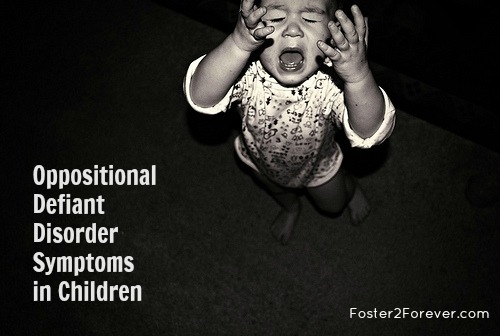
Help! Is This Oppositional Defiant Disorder?

Our strong-willed preschool son is a defiant one! This strong-willed Kindergartener has been so demanding and obstinate lately. And we are exhausted!

We recently attended a foster care training on mental health issues, such as depression, PTSD, ADHD.  And when the speaker showed the slide on Oppositional Defiant Disorder (ODD), our mouths fell open…

What is Oppositional Defiant Disorder?

ODD is a pattern of negative, hostile and defiant acts that lasts more than 6 months. (How about 2+ years?)

Symptoms of Oppositional Defiant Disorder

  • Loses temper easily
  • Argues with adults
  • Refuses to obey rules
  • Often annoys people on purpose
  • Blames others for his mistakes
  • Often touchy or easily annoyed with others
  • Often angry and resentful
  • Often spiteful

A child must exhibit at least 4 or more of the following symptoms to be diagnosed with ODD.

My son exhibits every single symptom of ODD!!!

Now don’t get me wrong – I am not diagnosing my son  with ODD! To the contrary, my prayer is that he does not have ODD.

Because…get this: He has had no tantrums at school this entire year! My observations are that he only exhibits these symptoms of ODD with his parents!  Since he only exhibits these symptoms with his primary caregivers, it could mean that he is expressing his needs due to his past trauma only when he feels safe – with his parents.

Read more about the overlapping symptoms of other disorders.

photo credit: demandaj via photopin cc

10:28 am by Penelope

Dealing with your Defiant Kid

Do you have a defiant kid too? I have a defiant, strong-willed son that I believe takes pride in challenging me. I love my little imp, but boy, he tries my patience!

I have been reading through The Connected Child: Bring hope and healing to your adoptive family and have been using a number of the strategies for connecting with your adopted child.

STEPS IN DEALING WITH CHILD’S MISBEHAVIOR

  1. Respond to misbehavior immediately.
  2. Redirect to better choices.
  3. Practice getting it right with a do-over.
  4. Praise for improved behavior.

But sometimes, my son is stubborn and simply defies me. Chapter 7 discusses Dealing with Defiance!  Here are some of the strategies I’ve been using from this chapter:

defiant-kid-toddler-daughter

STEPS IN DEALING WITH CHILD’S DEFIANCE

  1. If your child challenges you, move closer and assert your authority while giving your child a chance for a do-over.
  2. Then say something like: “It is NOT okay for you to talk to me or your dad like that. You can be unhappy, but you MUST talk with respect! Now try that again, son.“
  3. Many times I have to give my preschool boy a choice of talking nicely or a consequence. After a few moments, he usually turns around because he knows I mean business.
  4. Praise him for talking respectfully. “Good choice in talking nicely!“

The Connected Child recommends: “Use the least amount of firmness and corrective effort needed to resolve a situation.”

However, sometimes, these strategies may not work, and Chapter 7 of The Connected Child discusses dealing with defiance in more detail.

BE FLEXIBLE

To avoid a total breakdown, sometimes, I have to stay aware of my son’s “meltdown potential.”

Sometimes if he might be hungry, I realize that he isn’t capable of pulling himself together – so my first task is to get his blood sugar back up – before I deal with his defiance.


After he’s calm, then we talk about his misbehavior and even sometimes, I give him the choice of what his consequence for misbehavior should be. Funny story: One time, he decided his punishment would be “no wii for 20 months”.  I told him that would be nearly two years until he could play wii again, so 2 days of no wii would be fine.

What strategies have you found effective in dealing with the defiant personality of your kid?

8:00 am by Penelope

When Do-Overs Don’t Work: A Child’s BIG Emotions

I have a defiant child!  His challenging behaviors can be so frustrating as a parent attempting to help him.

Last month, I discussed the “Do-Over” as a technique to teach your child appropriate behavior as an alternative to other forms of discipline.

However, sometimes, such as during this scary blow-up rage at church, DO-OVERS JUST DON’T WORK!

My son, JD, was in full rage mode & nothing we could do was calming him down. We were desperate, and racing to the local hospital for help. In fact, he didn’t calm down until we actually pulled up to the hospital.

A few months ago, I read The Whole-Brain Child along with Lisa Qualls and a few of her readers of One Thankful Mom.

Child-Emotions-Behavior-Problems-Parenting

One of the helpful strategies that I began using during one of JD’s meltdowns is:

Whole Brain Strategy #2: Name It to Tame It: Telling Stories to Calm Big Emotions.

Name It to Tame It helps children not be overwhelmed by their feelings. The authors note that we can: “name and tame the emotions we are experiencing, rather than be{ing} overwhelmed by them.”  This storytelling process can help a child make sense of their experiences.

One thing that we’ve noticed with JD’s rages is that they usually occur when he hasn’t eaten a good meal in a while.  During these rages, I’ve began repeating to him: “oh, you must be hungry…you get really grumpy when you’re hungry…what would you like to eat?”

By adding these narrative details while JD is raging, I’m hoping to help him make sense of what he’s experiencing with these BIG emotions and what he’s feeling in his body.  Then hopefully, one day, he will realize that he’s hungry and just say “I’m hungry!”

That scary blow-up at church was so perplexing to us because he had eaten nearly two grilled cheese sandwiches before church!  That intense rage (the worst in over a year) frightened us more than ever about what could be going on inside our little boy’s brain.  I was in tears holding and praying over my son as we drove that ten minutes to the hospital.toddler-tantrum-foster-child-trauma-bonding-attachment

After that ordeal, when we finally made it home and walked in the door, what do you think Stinkpot said to me? Yes! That’s right!

I’M HUNGRY.

How do you help your child deal with BIG emotions?

You can read The Whole-Brain Child on your Kindle or listen through Audible (how I read it).

5:00 pm by Penelope

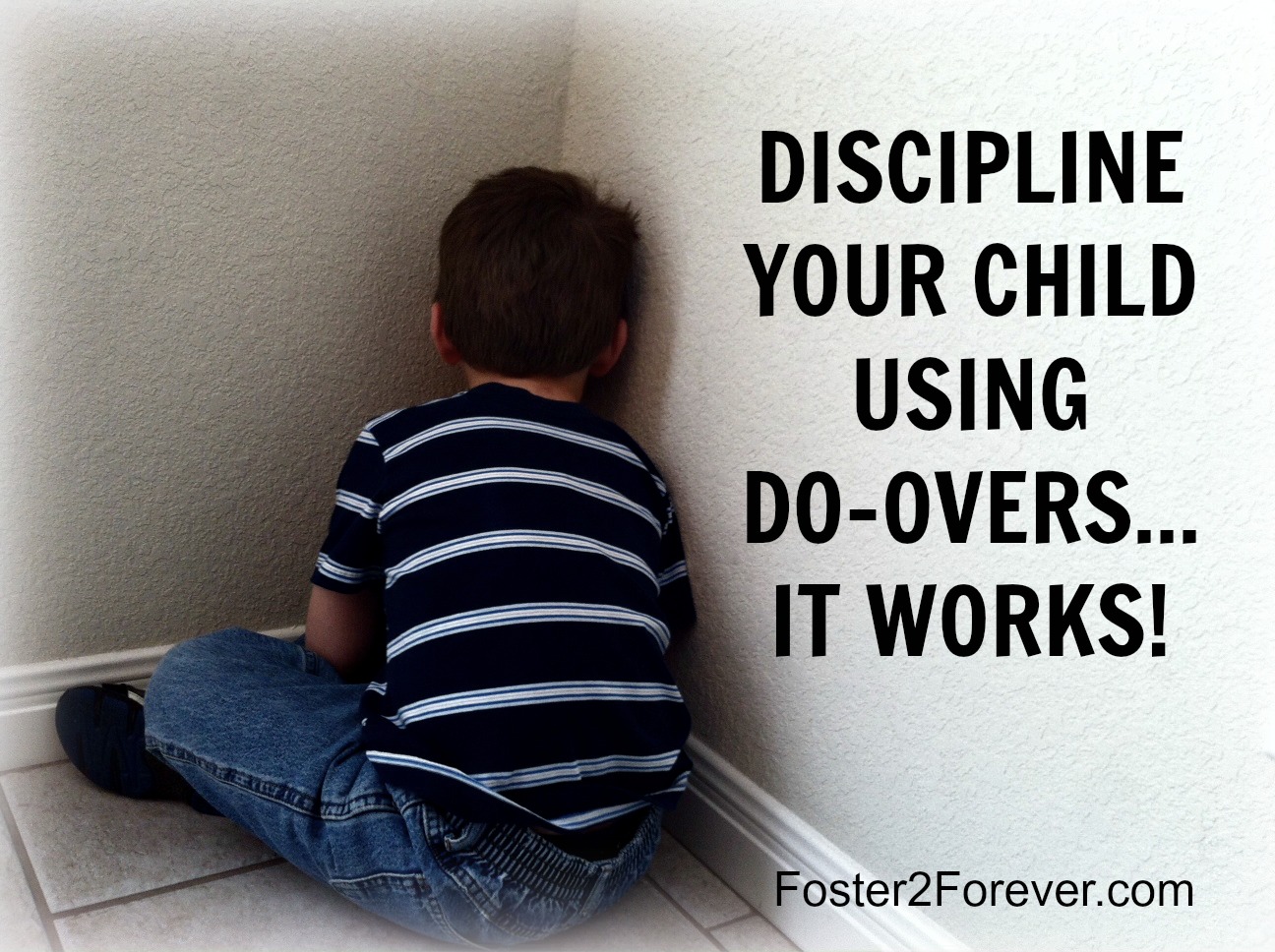
Using Do-Overs as Discipline?

Confession: I am the mother of a defiant, demanding, strong-willed child! I’m starting to believe “Misbehavior” might be his middle name. 🙂

My 5-year-old son, already a know-it-all, is 5 years old going on 15. What an attitude! (One doctor has diagnosed him with Reactive Attachment Disorder) And it’s with this child that I feel the most insecure about my parenting skills.

I certainly don’t want to punish him all the time for his constant misbehavior.  In just a short time, I can quickly take away every single privilege that this stubborn child has – with no real benefit.  His defiant behavior doesn’t change! And through all this misbehavior, I seem to be just punishing myself.


Enter the “Do-Over” – a concept originally introduced to me through his play therapist last year.

However, now that I’m currently reading The Connected Child: Bring hope and healing to your adoptive family by Dr. Karyn Purvis, the “do-over” is emphasized and explained in more detail.

The “IDEAL” Approach to handle misbehavior discussed in the book is:

I – Immediate response;

D – Directly respond to the child, making eye contact;

E – Efficiently use words and firmness;

A – Action-based “do-overs”;

L – Level your response to the behavior, not the child.

When my defiant child demands or says something ugly, a do-over has become such an effective tool to teach him the correct way to act or respond.

“Let’s try that again.” – “What’s another way to say that?” – “How can we do that differently?”

Through this method, my son is actively learning how to act appropriately in the world! A skill that, sadly, many foster children just haven’t learned due to their rough beginnings.

It’s just like learning any other skill – riding a bicycle, playing a musical instrument, making a basketball goal – practice, practice, practice!

Get the CALM-CONNECT-CORRECT PROGRAM: The Step-By-Step Process To Effectively Manage Behavior  –> Click HERE to learn more.


8:00 am by Penelope

My Kid Beat Up Your Honor Roll Student

I’m proud of our 5-year-old RADish, Stinkpot! He has done such a good job of keeping his temper in check at school. However, last week, I had to travel out-of-town on business for two nights. My absence didn’t go well for him.

On Monday night I wasn’t able to keep in touch, then Tuesday night, I finally figured out how to video chat around 6:30 pm. But it was too late! By that time, Stinkpot had already raged, and fallen asleep!

Aching for my child, I rushed back home Wednesday to pick him up from school, but it was too late!

rad-problem-behavior-issues-in-children


I rushed inside and while I was hugging and holding my stinky boy, his teacher approached, unhappy…

“He punched a friend on the playground! I gave him a warning, and then he went and punched another child. He said he did it just because.“

She was obviously surprised at his behavior. With me being gone, and him having such a bad evening at home, I’m not.

He made it seven weeks!

How long can your child be on best behavior?

  • « Previous Page
  • 1
  • 2
  • 3
  • 4
  • 5
  • 6
  • Next Page »

Looking for something?

Facebook

Foster2Forever

Archives

Why Every Foster Parent Needs Sexual Abuse Training

foster care visitation rules guidelines online

10 Tips for Foster Care Visitation Online

foster-income-taxable

Is Foster Income Taxable? What Foster Parents Should Know About Income Tax

Why Every Foster Parent Needs Sexual Abuse Training

I’m Clever

Sway

Pretty Chic Theme By: Pretty Darn Cute Design