Foster2Forever

  • Home
  • Shop
  • Fostering & Adoption
    • Foster Care
      • Being a Foster Home
      • Birthfamilies
      • Case Workers
      • Concerns
      • Court Hearings
    • Adoption
      • Parenting Tips for After Adoption
      • Benefits
      • Costs
      • Infertility
      • Parental Rights
  • Parenting
    • 31 Tips for Parenting After Adoption
    • Behavior Issues
    • Children’s Activities
    • Family Time
    • Motherhood
  • Our Home Life
    • Cancer & Health
    • Recipes
    • Marriage
    • Family Travel
    • Videos
  • Join Our Community
  • Our Family
  • Contact
  • Privacy Policy

3:09 pm by Penelope

When Your Child Is Throwing a Tantrum

If your child is like mine, when things don’t go their way,  they may haul off and throw a king-size “temper tantrum.”  When this happens there are a few things that you should remember that will help de-escalate the situation quicker when your child is throwing a tantrum.

throwing-a-tantrum

When your child is throwing a tantrum:

1.  Remain calm and listen

When you remain calm and listen to your child, you are more likely to find out the “real” reason for the temper tantrum.  Often the trigger that set off the temper tantrum is not the real reason for the emotions your child is feeling.  Maybe they are hungry, tired, or just frustrated from something that happened to them at school or daycare.  Listen to what they are saying, not the way they are saying it. Learn how to ask questions to learn more about what’s going on.

2.  Remove any onlookers if you can

Sometimes even well-meaning people can make things worse when your child is throwing a tantrum.  Siblings, relatives, or even friends can often say things that will escalate the child’s temper tantrum and cause the tantrum to last longer and possibly become more violent.  Try to remove everyone but you and the child from the room.  If that is not possible, try to remove the child having the temper tantrum from their audience.  Ask them if they want to go outside, maybe go for a walk, or go get a snack.  It us important that you find a way to be alone with your child in order to remove all distractions and focus on them.

3.  Don’t make threats or give ultimatums

When a child is in the middle of throwing a tantrum, the part of their brain that responds to reasoning is completely shut off.  In other words, they can’t hear anything you say.  Making threats or telling the child that some punishment will happen if they don’t stop will do no good.  Wait for the tantrum to run its course, then discuss consequences later when the child is calm and can listen.

4.  Validate your child’s feelings

Telling your child that you know how they feel and letting them know you understand why they are upset will go a long way in helping to de-escalate the temper tantrum.  After your child is calm, you can then talk to them about more appropriate ways to handle their emotions. (A great way is to role-play)  But they do need to hear, that it is “normal” to get mad.

Read more in this series on parenting techniques.

 

1:25 pm by Penelope

My Home Is A Different Country For Him

How constant moving through foster homes can really hurt a child.

Being 7 at the time, my foster son was very conscious of his life when he first came to live in our home. He had been in another foster home, where he had spent a full year. One of his first comments, once I introduced him to his very own bedroom was: “It smells here…” In reality, it didn’t. I explained, “I know it feels like it smells, but actually, it simply smells different.”

When I first entered the USA, everything was new to me. Not only the language sounded like nonsense, but the smell of the air was nothing familiar either. I remember when I was at the airport, with my friends, tired as we were, we sat on the floor. A cleaning lady approached and began talking to us. We didn’t understand what she was saying — I think, maybe, we were not supposed to sit there.  We didn’t speak her language. We were travelers.  It was scary when someone would talk to me and I couldn’t understand.

At another time, I remember being confused, also at the airport. After asking the flight attendant a question, she got really offended at me. I think I must have expressed myself the wrong way. I was an exchange student, missing home. I was just afraid I was going to miss my flight.

For a foster child, the experience of a new foster home is very similar to mine. The child is a foreigner in the new home.

A therapist, making the case to defend permanency for a child who had already spent years in foster care, stated: “With every move, a child goes through the same shock as someone does when moving to a new country.”

foster-homes-older-child-adoption-stories

My son needed plenty of time to adjust to us. A world had been ripped from him and a completely new one was given him, all at the same time, without having any say.

If an adult can panic at the thought of being dropped off in a strange land… Imagine a child, who has to face all new things? How many traditions did he have to learn? How many different rules did she have to learn at the several schools she has had to attend? How many times did they feel alone and lost and needed someone to explain the directions?

These are heavy experiences!

A child needs stability, permanency. Her brain needs time to absorb and adjust. His heart needs a break…

Many foreigners fall into depression because of the overload of new information they must accept. And we are talking about adults, who have chosen to move from their home country into a new one. But a foster kid did not ask for the move. Still, we require full acceptance from them. So, we must give them space and time once they arrive… And permanency.

Understanding from us to them.

Patience.

Kindness.

Respect.

A never-letting-go attitude.

You know, when that flight attended got mad at me, what helped was when a kind soul stopped by and helped us understand each other. It is hard to forget the relief that I felt when her compassionate eyes met mine at a time when I was a tiny person in a very wide world.

Our little ones are travelers, worn down travelers, foreigners in need of those compassionate eyes.
Join our Facebook page  to connect with other adoptive parents!

GloriaRGloria R. is a mother of two birth children, and fostering to adopt an older child. She is  a licensed therapeutic foster parent with her husband. She continues to engage in research on traumatized children, foster care and adoption and hope to be a voice for kids, who often fall in between the cracks of society. She also loves writing and welcoming new readers to her blog, www.onemorewithus.com.

10:00 am by Penelope

Will Your Smoke Detectors Pass a Fire Inspection?

Do you have enough smoke detectors to pass your fire inspection?

When we were seeking our license to become foster parents, one of the requirements is to pass a “FIRE INSPECTION.”  Fortunately, Texas lays out the requirements directly in the foster home and State Fire Marshal rules.

However, many states don’t specify the requirements for smoke detectors — you have to rely on finding these yourself or scheduling the fire inspection only to discover that you need another smoke detector.

Here are the requirements for smoke detectors to pass a fire inspection in all 50 states. Great resource for licensing foster homes.

For a fire inspection, the State of Texas requires working smoke detectors:

  • In every sleeping room;
  • In the hallway near sleeping rooms;
  • At the top of stairs in two-story homes (in addition to sleeping rooms).

The State Fire Marshal rules also state:

“Batteries shall be changed at least annually. Statistics show about one-third of the smoke detectors installed in homes are inoperative. When detectors are non-operational, the usual reason is dead or missing batteries.”

You can find other state fire marshal requirements for smoke detectors here. 

Energizer®, in partnership with the International Association of Fire Chiefs (IAFC), strives to keep families safe through the Change Your Clock Change Your Battery® program (CYCCYB).  

Households with non-working smoke alarms now outnumber those with no smoke alarms. (mostly due to dead batteries)

On Daylight Savings Time when you are already changing your clocks in your home — be sure to change and test the batteries in all your smoke and carbon monoxide detectors.

Do you have the required number of smoke detectors for your home?

11:30 am by Penelope

Can My Child Ever Love Me? Bonding with Adopted Child

As sun is to warmth and tickles are to laughter, a loving mom is to a child who loves her back, right? But how does that look when the child is a deeply hurt one, one who was not born of you, who has not asked to be fostered by you, who comes from a life of betrayal and abuse? How do you begin bonding with an adopted child?

bonding-with-an-adopted-older-child

When Boy first arrived, he would openly push me away, say he didn’t like us or our home. He said many times that he didn’t want to be here. He told me once he would never trust me.

Throughout his stay with us, I tried different methods of awakening trust in him. He clearly had reactive attachment disorder (RAD) and needed help with connecting to a caregiver. The only way to help him let go of his mistrust was to purposefully exercise the opposite, his trust (or whatever was left of it). So, I would “schedule” bonding time for us.

Bonding with an adopted child

Look into my eyes and count to 5.
I will hold you in my arms, and we will rock back and forth 20 times (looking into my eyes).
We will sit together, looking into each other’s eyes and talking, for 15 minutes. – I would ask him to tell me a story, any story, while looking at me. His first one was as short as this, “There was a bear. And a ball. The end.” I would ask about the color of the ball, what kind of bear and so on.

He would always complain at the beginning of those “sessions”. At first, he would jump up and just about run from me at the end of each cycle… But, with time, he began to relax. His stories would go further, he would linger around after time was up, looking into my eyes became easier. It came to a point where we “graduated” from those connecting times as things became more natural.

As we practiced attachment, love began to blossom. Not that he would write me love letters… But that I could see the sparks of love inside those eyes, who at first were filled with pain. Trust began to push away the monsters, and love began to conquer his darkness.

You see, a relationship takes time to form. It is one day at a time, through the ups and downs, experience filling the “life-book” of two people investing in each other…

After 14 months, looking into my eyes is an easy task. He smiles at me, knowing I mean every moment I spend with him. He holds my hand, plays with my hair, seeks closeness.

Come to think of it, the moment you receive your child, is the moment when love begins, really. Though he still struggles with expressing it, I know love is there… Because love started with me.

So, as sun is to warmth… Because the sun initiated it… And as tickling is to laughter, because laughter is a result of the tickling… So your child will love you… Because you loved your child first.

Join our Facebook page  to connect with other adoptive parents!

GloriaRGloria R. is a mother of two birth children, and fostering to adopt an older child. She is  a licensed therapeutic foster parent with her husband. She continues to engage in research on traumatized children, foster care and adoption and hope to be a voice for kids, who often fall in between the cracks of society. She also loves writing and welcoming new readers to her blog, www.onemorewithus.com.

10:00 am by Penelope

He Doesn’t Call Me Mom- Older Child Adoption

It was tucking-in-bed time. He’d been quiet, withdrawn, and I could tell why.
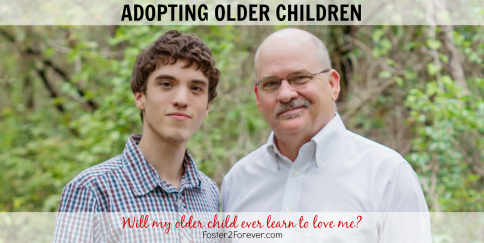
My son is an older foster child, whom we are in the process of adopting.

A heartfelt post about older child adoption. #fostercare

At 5 years of age, my foster son entered the system. He came to us at age 7. He is now 8. Not to say his life became chaotic after he became a foster child. He lived in chaos much before then. Neglect and other forms of abuse were normal to him. Expected. Taught. Absorbed.

His removal from birth mom was a necessary call. The dangers outweighed the benefits of living in such environment. What am I talking about? There was no sure environment, for starters. Her rage and drug abuse took her away for long periods of time, as she farmed her kids around. Due to her inability to parent, my son was under such stress that he developed stress induced epilepsy… Which she was unable manage properly. Lack of medication or the will to administer the doses, not sending the medications to the caretakers (often, questionable ones, some were abusers themselves), all could have caused her son permanent brain damage. And aside from all of that, violence from her were both witnessed and experienced first hand, by him.

With such a long history of trauma involving her, you would think my son would want to forget all about her, wish she would never harm him again… But it isn’t so. He loves her. He always will.

If we were preparing him for reunification, it would make sense to promote their immediate relationship. We did, when they were trying to make that happen. However, her rights were rightfully terminated.They will form a better relationship some day, but not for now. His emotional wounds are too fresh… In fact, he doesn’t demonstrate the desire to move in with her again… Still, he loves her. He misses her eyes, her hair… I imagine he misses those short periods of time when he nestled in her arms, sensing her smell, listening to her voice.

We are preparing to adopt him, so it stung when I was reminded of this extension of his heart, his birth mom. Though he was next to me physically, he was close to her emotionally. What to do? How to cope with that?

So I hugged him. I told him I was so sorry for all the hardships of his life. He held my hand and asked me to stay with him for a while longer. I did. Then, I kissed him good night.

Mothering an older foster/adoptive child is hard. The “mother” seat may be taken already… Though, there is a place for me. For the honor of being called “mom” may not be mine, not yet anyway… But I have the honor of having him hold my hand as he travels across the state to find her in his thoughts. It was my arm he clung to as his heart tightened. It was in my embrace he buried his sweet little head, searching for comfort. My honor is to be counted trustworthy enough to accompany him in his journey.

Oh, why am I tearing up at this? Perhaps, because when I call him “son“, the echo does not reply, “mom“. Rather, it evokes the silent beauty of a new found trust, from a heart previously shattered, an echo expressed by his hand holding mine.

Join our Facebook page  to connect with other adoptive parents!

GloriaRGloria R. is a mother of two birth children, and fostering to adopt an older child. She is  a licensed therapeutic foster parent with her husband. She continues to engage in research on traumatized children, foster care and adoption and hope to be a voice for kids, who often fall in between the cracks of society.


This is so touching! Older child adoption from foster care.

10:08 am by Penelope

My Struggle to Get My Son to Take Medicine

Earlier this week, my kindergartner woke up with a HORRIBLE hacking dry cough and no voice. I was surprised since the temperature outside is still in the 90s here in Texas.

“Cold season” generally runs from September to April!

I didn’t realize that colds begin this early in the school year, but, of course, those are the months the kids are in school spreading their germs with all the other kids.

Although my kindergartner will eat just about anything – if you say the word “medicine” – he will start whining, crying, begging, and hiding. Isn’t that weird? Giving this child medicine can become an incredible struggle! Many times, before it’s over, we’ve had to resort to putting the medicine in a syringe, holding him down, and slowly squirting it in his mouth, just to get the medicine in him!!! And then he will just spit it out if we don’t watch…. How many of you can relate to this scenario???

In a new national survey of U.S. parents of school-aged children (ages 4-13), 40% say that they find it isn’t always easy to give their children over-the-counter liquid cough and cold medicine.

Dr. Cocoa™ for Children had sent me their products to try so I thought we’d try the Dr. Cocoa™ products that are made with 10% real cocoa — maybe my son might be more willing to take this medicine if it was flavored with “CHOC-WAT” (my son’s cute way of saying “chocolate“).

Dr. Cocoa™ Long-Acting Cough Relief is so chocolate-y that my son licked it up! (because it’s that thick) He even said “Yummy!” That’s the first time that’s happened!

To be honest, I was skeptical about chocolate-flavored cough medicine, but since trying it, I have been telling my family and friends about the Dr. Cocoa™ products that really is chocolate-flavored. Now I want Dr. Cocoa™ to make a children’s pain reliever! How about it, Dr. Cocoa™?

Like the Dr. Cocoa™ Facebook page to win a Dr. Cocoa™ hand puppet.

Here is a $2.00 off coupon so you can try Dr. Cocoa™ for Children yourself. You can buy Dr. Cocoa™ for Children at these locations.

Disclaimer: This is a product-provided, sponsored conversation that contains affiliate links. But this is my true experience with Dr. Cocoa™ for Children products.

Visit www.drcocoa.com for a $2-off coupon offer.

11:59 am by Penelope

A Yummy Way to Find Homes for Foster Kids

I was heartbroken. The doctor’s words pierced my soul, and I was shattered. Would I never become a mother? Would I never be called “Mom”?

During my grief of infertility, my amazing husband reiterated his faith: “There’s a child out there that is our child; a child that may already have been born; a child that needs us to be his parents.” I shook my head in disbelief with tears flowing down my face.

I didn’t realize how right he was —
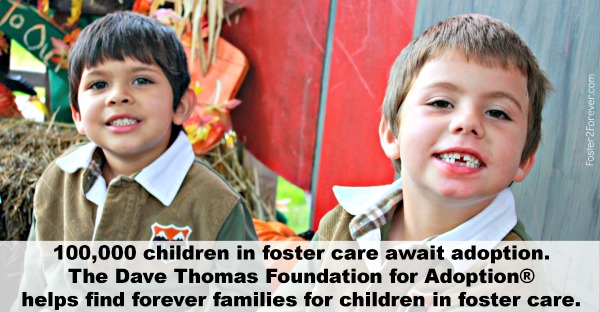
Did you know that more than 100,000 children in foster care wait for a family?

In 2007, we licensed our home and opened it to children that needed a family, whether for a while or forever. During that time, we have been parents to 16 children, some for a while — and two FOREVER!!!

wendys-frostys-adoption-foster-care-100000

The Dave Thomas Foundation for Adoption® believes that we all have a responsibility to be the voice of foster care adoption, so that every child finds a family.

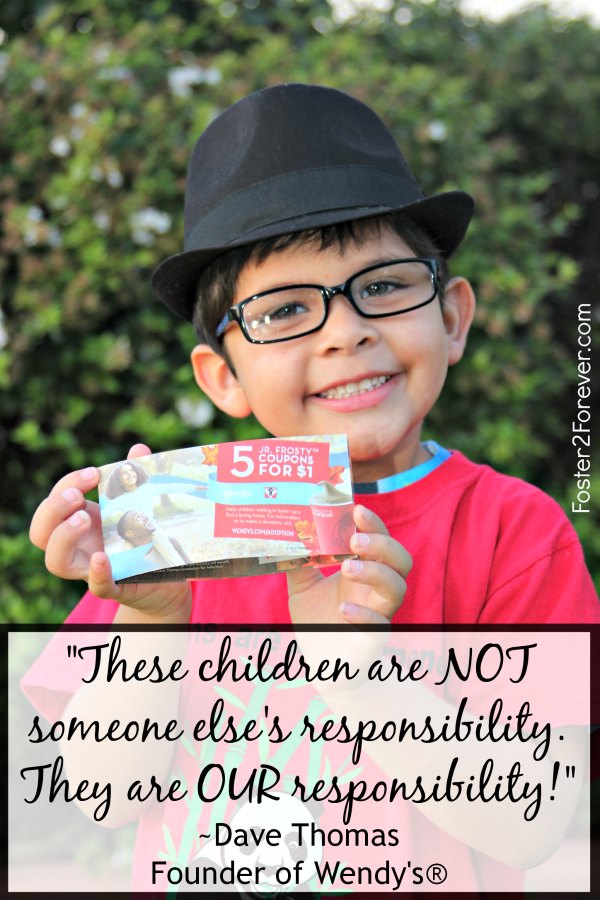
These children are NOT someone elses responsibility. Love this quote by Dave Thomas of Wendys.

You don’t have to become a foster parent, or adopt a child in order to help children in foster care find families!

The Dave Thomas Foundation for Adoption® exists to find homes for the 100,000 children who are waiting to be adopted from foster care in North America.

What you can do to support the DTFA and the 100,000 children in foster care awaiting adoption!

  • Visit your local Wendy’s® to purchase a Jr. Frosty™ Halloween Coupon Book* for $1, which benefits the Dave Thomas Foundation for Adoption®!

*Coupon book may contain coupons for 5 or 10 free Jr. Frosty™ treats. Prices and participation may vary. Ninety cents to every $1 coupon booklet sold benefits the Dave Thomas Foundation for Adoption®. 

Get your Frosty coupons from Wendys to support foster care adoption.

I was selected for this opportunity as a member of Clever Girls Collective and the content and opinions expressed here are all my own.

8:05 pm by Penelope

How Eye Contact Can Create a Strong Bond with Your Child

One of the best ways to connect with our children (or anyone, in fact) is by making eye contact a habit. Eye contact shows that you value your child. Direct eye contact is beneficial to the child and can help increase the child’s focus and ability to connect with people.

Many times, as a parent, I found myself busy doing something – wrangling babies, cooking dinner, picking up, on the computer, etc. – and my son would say “Mom, you’re not listening to me.”  Since realizing my bad habit and how detrimental that can be to our relationship, I make a concerted effort to STOP and look directly at my son when he is talking to me.

One-on-one full attention with your child cements a parent-child connection that every child needs and deserves.

At-risk children may be uncomfortable with direct eye contact, especially in the beginning. An abused child may even be fearful of eye contact due to previous traumas.  Don’t rush a fearful child into direct eye contact, instead practice for short bits to help the child overcome his fears and earn your trust.  (Also, keep in mind that in many Asian, African, and Latin American cultures, extended eye contact may be viewed as an affront or a challenge of authority.)

  • Move your head so that the child can see your face
  • Stop speaking for a moment to get the child’s attention
  • Use the phrase “Let me see your eyes“

“Never use eye contact as an excuse to give your child a mean or angry stare; instead use your eyes to communicate in a loving and nurturing way.” from The Connected Child: Bring Hope and Healing to Your Adoptive Family (affiliate link)

Great advice on bonding with your child! #adoption

6:30 pm by Penelope

4 Attachment Types To Know Before Becoming a Parent

Attachment can be defined in a number of ways, but can be simply defined as the connection that is developed between a child and caregiver. There are 4 patterns of attachment that a child can develop while being parented, but first…

How is attachment developed?

Attachment is developed through repeated and consistent interactions between a child and caregiver. If this cycle is repeatedly met (doesn’t have to be perfectly met, thank goodness), a child will develop a secure attachment.

 When is attachment formed?

Attachment patterns are developed during the first 12 months of life!

Attachment patterns are usually stable over a person’s lifetime! (The attachment style a person develops as an infant will remain their attachment style as an adult UNLESS the person DELIBERATELY attempts to change that attachment style)

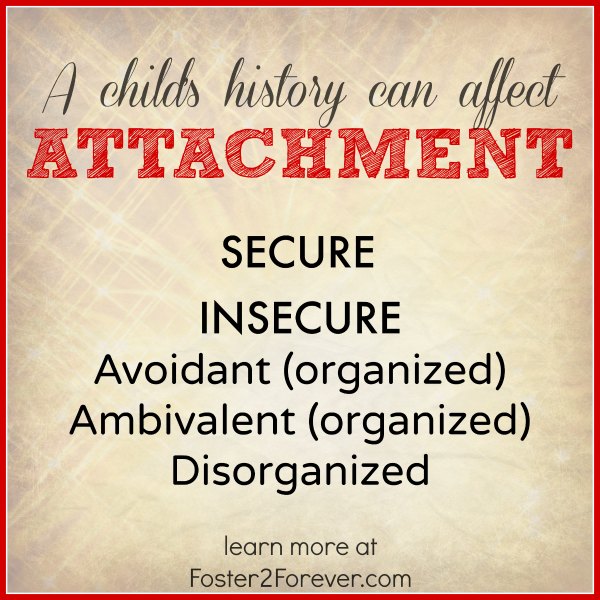
4 ATTACHMENT PARENTING TYPES

  1. Secure
  2. Insecure – Avoidant (Organized)
  3. Insecure – Ambivalent (Organized)
  4. Insecure – Disorganized

A child's behavior can be linked to attachment issues as an infant! #fostercare #adoption

1. SECURE ATTACHMENT TYPE

How is Secure Attachment Developed?

  • Touch, closeness, eye contact – Think of how you hold an infant and look into his face
  • Emotional attunement – Tuning into the internal state of another
  • Secure environment – Feeling safe and cared for
  • Shared pleasure, play, and FUN!

Characteristics of Secure Attachment Type

  • Seeks out caregiver when in need of physical or emotional support or comfort
  • Ability to talk about a wide range of feelings, both positive and negative
  • Feels comfortable exploring new environments while continuing to use their caregiver as a “secure base”
  • Enjoys and is comfortable with physical and emotional closeness
  • Positive beliefs about themselves, others, and the world
  • Emotionally stable (emotional regulation)

2. INSECURE-AVOIDANT ATTACHMENT TYPE

How is Insecure-Avoidant Attachment Developed?

  • The infant is repeatedly NOT soothed
  • The attachment cycle is broken, and the distressed infant stops asking for help
  • The infant is left unattended, in neglectful families or orphanages
  • Sadly, the infant still produces stress hormones, yet doesn’t act stressed
  • The infant learns not to depend on anyone to soothe or meet his needs

Characteristics of Insecure-Avoidant Attachment Type

  • Emotionally distant and aloof
  • Limited tolerance for feelings
  • Inflated self-reliance to minimize need for connection
  • Independent or inappropriately mature
  • Lacks empathy
  • The child’s solution is limited dependence on relationships. Take care of self. Deny or avoid feelings or emotions.

3. INSECURE-AMBIVALENT ATTACHMENT TYPE

How is Insecure-Ambivalent Attachment Developed?

  • The distressed infant sometimes has his needs met
  • The caregiver is inconsistent (due to their own unresolved attachment histories, or could be due to substance abuse or mental illness)
  • Disruptions is care due to inconsistent or chaotic caregiving (also displacements via foster care)

Characteristics of Insecure-Ambivalent Attachment Type

  • Crave attachment yet pushes away (push/pull behaviors)
  • Clinginess (bottomless pit)
  • Unable to self-soothe (as they get older) and need all soothing from an outside source
  • Fear of abandonment
  • The child’s solution is to keep caregivers in constant proximity

4. DISORGANIZED ATTACHMENT TYPE

How is Disorganized Attachment Developed?

  • Caregiver is frightening, dangerous, or causes terror
  • Child needs the caregiver for survival but is terrified of the caregiver
  • Child cannot find a solution which results in disorganized attachment

Characteristics of Disorganized Attachment Type

  • Significant difficulty with behavior, emotions, attention, and relationships
  • Attempts to control their caregiver in order to make them more predictable
  • Prone to dissociation
  • 80% of abused children have disorganized attachment (Siegel)

To learn more about attachment and how your parenting can affect your child’s attachment, you can read Parenting from the Inside Out: How a Deeper Self-Understanding Can Help You Raise Children Who Thrive by Dan Siegel (Amazon affiliate link).

  • « Previous Page
  • 1
  • …
  • 10
  • 11
  • 12
  • 13
  • 14
  • …
  • 45
  • Next Page »

Looking for something?

Facebook

Foster2Forever

Archives

Why Every Foster Parent Needs Sexual Abuse Training

foster care visitation rules guidelines online

10 Tips for Foster Care Visitation Online

foster-income-taxable

Is Foster Income Taxable? What Foster Parents Should Know About Income Tax

Why Every Foster Parent Needs Sexual Abuse Training

I’m Clever

Sway

Pretty Chic Theme By: Pretty Darn Cute Design