Foster2Forever

  • Home
  • Shop
  • Fostering & Adoption
    • Foster Care
      • Being a Foster Home
      • Birthfamilies
      • Case Workers
      • Concerns
      • Court Hearings
    • Adoption
      • Parenting Tips for After Adoption
      • Benefits
      • Costs
      • Infertility
      • Parental Rights
  • Parenting
    • 31 Tips for Parenting After Adoption
    • Behavior Issues
    • Children’s Activities
    • Family Time
    • Motherhood
  • Our Home Life
    • Cancer & Health
    • Recipes
    • Marriage
    • Family Travel
    • Videos
  • Join Our Community
  • Our Family
  • Contact
  • Privacy Policy

8:57 am by Penelope

Giving Up the Idea of Ideal

Before being licensed as foster parents, my husband and I were required to complete a training course called Group Preparation and Selection, or GPS. Every Monday night, for 10 weeks, we joined with other prospective foster/adopt parents to learn how the system works, what to expect as foster parents, and how to deal with children who have experienced loss and trauma. The classes were very beneficial and we learned a lot but in foster parenting, like in any other type of parenting, you have to be adaptable.

For instance, in GPS classes we learned that to ease the transition of a move it’s best to have several visits with a child before they move into your home. However, our reality is that 2 of our 3 children that we foster adopted moved in with us on the day they met us. Obviously this is not ideal, but the children were emergency removals. Fortunately, bonding took place very quickly and both children have adjusted very well to our home.
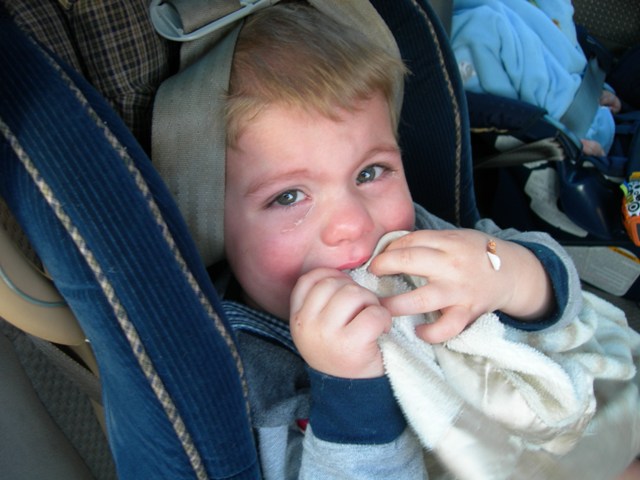
Another thing you learn in your training is that ideally you should build a relationship with your child’s previous foster family, as this builds trust between you and the child and eases their transition into your home. We tried this with both of our daughters’ previous foster families, but were unable to do so with our son’s because of the abuse he suffered from his foster mother. With one daughter, the foster parents didn’t care to maintain contact. We made several efforts to keep them in our daughter’s life yet they made it clear that they just weren’t interested. After only a couple of visits they were done with her whether we liked it or not. With our other daughter we tried to establish a relationship with her foster family, but the former foster mom was so bitter about not being allowed to adopt the child herself (She made some poor decisions that caused her home to be closed as a foster home.) that her self-destructive behavior made subsequent visits out of the question.

However the most surprising difference between what we were taught in GPS training and reality actually is ideal. In the classes you learn about how abuse, neglect, and loss affect children in foster care. You are taught about the stages of grief, creative discipline strategies, and attachment disorders. We were sure that the children placed with us would come with some major emotional baggage. Our first daughter had absolutely no behavioral or emotional issues whatsoever. She was the perfect 3 year old. So perfect in fact that our social workers were quick to warn us not to expect any other foster children to be that way. Our second daughter, easily our most difficult child, has ADHD and was buckwild when we got her. After only a small amount of time in our home we could see a huge improvement and she gets better every day. We are her 8th home, yet she is no more damaged than most other children her age. She is amazingly resilient. Our youngest son has only been with us since last June and already it’s like he’s been with us forever. He’s never had any unusual behavioral problems. He has ADHD and requires a little extra help with his school work, just like many kids who have never been in foster care.

For those of you considering foster care, learn all you can in your classes. Most of it is very valuable information that you will need and use. Just don’t forget that no situation is ideal and that’s ok. All of my children have been ideal, even if their situations didn’t start out that way.

transracial-foster-care-adoptionBecky Johnson is a happy wife and proud mommy of four, both by birth and foster care adoption. Because two of her adoptions have been transracial, her family often gets mistaken for a daycare or church group when out in public. Life in the Johnson home is fun, chaotic, and definitely blessed. Read more about Becky’s family at http://averyblessedmommy.blogspot.com

9:00 am by Penelope

Do You Celebrate Your Adopted Child’s Culture?

This past weekend was Cinco de Mayo, a celebration for those of Mexican descent.  Although, now a U.S. citizen, our 2-year-old Lil Bit was born in Mexico.  During our struggle to keep Lil Bit in our family, we felt pressure from Lil Bit’s CASA worker as she kept saying over and over: “He needs his Mexican culture.”  During this ordeal, my thoughts were that we can learn and teach him Spanish, and I do cook Mexican food a couple of times a month — We are in Texas, for Pete’s sake. With a Mexican restaurant on every block, Hispanic culture surrounds us.

Mexico

However, lately I have internally stressed over learning Spanish and how to “become more Hispanic” for my Mexican child.

I recently finished “reading” Adopted for Life by Dr. Russell Moore, a leading Christian adoption advocate.  As I listened to Dr. Moore reading the audiobook to me, I was comforted by his words (paraphrased from Chapter 1):

“We will teach our boys about their cultural heritage…I will teach aspects of Russian culture but not with the same intensity….They eat what we eat…They share our lives and our story…They’re Moores now with all that that entails…”

I began to think about all the families we know with one Mexican spouse – relatives, neighbors, and long-term friends – and how they integrate Mexican culture into their families. Of those, only half actually teach their children to speak Spanish, mainly because the grandparents primarily speak Spanish.  However, most do teach a few words of Spanish, as do we.  Although, I didn’t have a Hispanic parent or take a Spanish language course, I know a bit of Spanish vocabulary I learned through Mexican friends, roommates, travel, and Sesame Street.

Would I like to learn to speak Spanish? Yes! I would love to one day be able to hold a conversation with someone in Spanish. That is something I plan to do when we eventually homeschool our children. But we will learn Spanish as a family – not only for our Mexican child, but for our entire family.

As Dr. Moore also points out in his book, parents shouldn’t point out their adopted children’s differences.  We don’t want Lil Bit to feel different in our family just because he is Hispanic, he is our son and we want to instead point out how much he is like us.

(On a side note, I met a co-worker of FosterDad’s at a local park this week – when she saw Lil Bit, she said, “He looks like your husband.” — Take that Ms. You-can-tell-by-looking-at-him-that-he’s-not-yours CASA worker!!!)

We do want our Mexican child to be proud of his first culture; however, he is now our American son, and we did not celebrate Cinco de Mayo this year. (It’s t-ball season)

What are your thoughts on keeping cultural heritage?

9:00 am by Penelope

Why Does My Child Act Like This? Could It Be RAD?

We began our foster care journey in the early 80s, and in 1985, we adopted a six-month-old baby girl from foster care, with known exposure to alcohol in utero. She smiled from the moment I saw her. She liked almost everyone at first meeting, and brought them books to read and toys to play with. She climbed into every willing lap she saw. She wasn’t much on cuddling, but as my mother said, “some kids are, some kids aren’t”. Although I didn’t know it then, I had just adopted my first child with Reactive Attachment Disorder (RAD) and FASD (Fetal Alcohol Spectrum Disorder).

rad-signs-in-children

Types of Attachment

Attachment between a mother and her child is the bond formed between them, and the foundation of all future development. The ideal bond is a Secure Attachment.

An Insecure Attachment occurs when something interferes with the bonding between the mother and child, such as in utero alcohol or drug use, physical abuse, or extreme stress experienced by the mother. Early neglect, physical abuse, sexual abuse, prolonged separation, major illness, or multiple changes in caregivers in a child’s early years can also interfere with a healthy attachment.

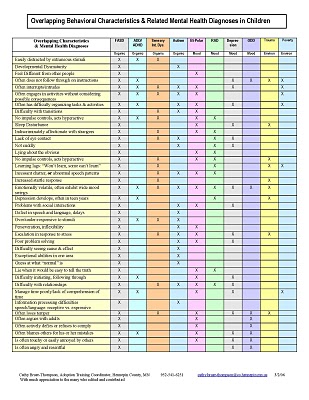
Attachment disorders come in degrees of severity, with the most severe being Reactive Attachment Disorder. Very few children, even those with RAD, have all of the following symptoms. Since a number of the major psychiatric disorders have overlapping symptoms, you should take any child you are concerned about for a full evaluation by a competent psychiatrist.

Overlapping Behavioral Characteristics – Click on the image to see full chart

 Symptoms of Reactive Attachment Disorder

• Superficially engaging & charming • Lack of eye contact on parents terms • Indiscriminately affectionate with strangers • Not affectionate on Parents’ terms (not cuddly) • Destructive to self, others and material things (accident prone) • Cruelty to animals • Lying about the obvious (crazy lying) • Stealing • No impulse controls (frequently acts hyperactive) • Learning Lags • Lack of cause and effect thinking • Lack of conscience • Abnormal eating patterns • Poor peer relationships • Preoccupation with fire • Preoccupation with blood & gore • Persistent nonsense questions & chatter • Inappropriately demanding & clingy • Abnormal speech patterns • Triangulation of adults • False allegations of abuse • Presumptive entitlement issues

Treatment of RAD

Children with attachment disorders who do not receive appropriate interventions frequently develop personality disorders as adults. RAD is the most severe attachment disorder and has the poorest outcome, especially if left untreated.

The younger the child, the less symptoms you are likely to see. We adopted a 4 ¾ year old in August 2010, from a disruption. She is now 6 ½ and diagnosed with RAD. The only two symptoms she doesn’t currently display are preoccupation with fire and preoccupation with blood and gore.

She attends a day treatment program held in one of the local elementary schools. She has therapy three times a week, sees the psychiatrist every two weeks. We recently were approved for waiver services, which gives us 24/7 crisis support, skill-building programs, and respite care.

We encourage eye contact with chocolate, incorporate as much good touch into play as possible, and refuse to allow her to sabotage the big family holidays with her behavior. We are even taking her on a cruise this summer with us, although a friend who is trained in providing respite is coming with us. We are currently looking for an attachment therapist, preferably trained by Dan Hughes in Attachment-Focused Family Therapy.

A child with RAD needs intensive support to heal. We have recently began implementing the “Parenting in SPACE” through Safety, Support, Supervision, Structure, Playfulness, Acceptance, Curiosity and Empathy. We feel that this paradigm gives us the best chance to help our RAD daughter heal. Providing safety, support, supervision, and structure are mandatory. Playfulness, acceptance, curiosity, and empathy are the things that differentiate a family from an institution.

Raising a child with RAD isn’t easy; however, as we see progress in our daughter, we find the rewards.
You can read more about attachment parenting in these books:
Attachment-Focused Parenting: Effective Strategies to Care for Children ,
When Love Is Not Enough: A Guide to Parenting Children with RAD,
The Connected Child : Bring Hope and Healing to Your Adoptive Family, or
Easy to Love but Hard to Raise: Real Parents, Challenging Kids, True Stories.

GBsMom is 55 years old and working on a PhD in Educational Psychology. She has been an adoptive and foster mother for over 30 years. Most of her kids have been some combination of Bipolar, FASD, RAD, ADHD. She has been married for 35 years and is raising her second family, GB, 9, and Hope, 6. She blogs about her life at Adopting Special Needs.

9:00 am by Penelope

Can You Stay Home with Your Foster Children?

Because of his explosive behavior, our son had gotten kicked out of his second daycare before Christmas 2010. He was only 3 years old!

I had ignored my rights under the Family and Medical Leave Act (FMLA) and not taken time off work when he was first placed with our family in March 2008 or for his adoption the next year; but I wouldn’t again! So last spring, I took family leave to spend more time with my 4-year-old. My little boy needed his mommy!

I enrolled him in a couple of Mother’s Day Out programs, working part-time, giving me the ability to extend my 12-week leave throughout the spring until school was out when he could stay home with FosterDad (a teacher). I continued working to ensure our medical insurance would be paid.

Our son improved tremendously! No melt-downs or tantrums at MDO the entire spring or summer!!! (I wish I could say the same for at home)

Last fall, thinking a year at home had helped him, we were excited to enroll our son into highly-regarded daycare/preschool in our area. He had been on the wait list for two years!

At 4-years-old, he seemed ready. And he was — for only about 8 weeks; the stress of all-day care finally caught up with him. His explosions were worse! More out-of-control than ever!

We had to do something! We made the difficult decision to try psychotropic medications. His explosions continued.

We knew by experience that his time at this preschool was limited. FosterDad quickly found a place in the Pre-K class at the public school where he taught. My stomach was in knots. We were not solving the problem, just transferring the problem somewhere else. I knew in my heart it wasn’t the right thing to do. I needed to leave my job to stay home with my son.

Then, while at work on the morning of November 10, 2011, I was silently crying and praying when I received an email from one of God’s messengers.

A person from Human Resources had written to ask me if the time I had taken off the week before was FMLA. What?!

My fingers raced to place a call.

“Didn’t I use up all my FMLA hours?”

“No?” I was still eligible for over 100 hours of FMLA that didn’t expire until the end of January!

I was overwhelmed by God’s hand on me that morning.

My Facebook post that day read: “When feeling down and confused, blessings from above can make you soar above the clouds! Thank you, Lord, for your unexpected blessings!”

I never shared that with you since we were busy with Adoption Day preparations and trying to decide whether to add Lil Bit’s newborn sibling to our family.

I enrolled him in the half-day Pre-K at the local elementary school, and began picking him up for lunch every day.

JD was excited about going to “big school” where the neighborhood kids attend.

FosterDad began full-time family leave in February, and goes back to school today – for one month until school is out – then he retires June 1st!

Not that our son hasn’t had a couple meltdowns at the new school. (Fortunately, public schools can’t kick kids out for bad behavior) But he has adjusted and is doing much better.

Our son even won an award at school! Okay, full disclosure, it was a perfect attendance award, but we are proud of him, nonetheless.

I’ve reapplied for FMLA for the month of May – So today, I’m excited to begin my time off with my little boy! There’s nothing like Mommy and Me time!!!

9:00 am by Penelope

Does Adoption Cure Infertility?

As an advocate for foster care and adoption, I wish I could say that we began this journey out of the goodness of our hearts, that we felt compassion for the children who could not be with their original family, and that we desperately wanted to provide a home to those in need.  I wish we could say that we have always wanted to be foster and adoptive parents, but that is not our story.  We are infertile.  It was only after struggling through an uncorrectable, secondary infertility diagnosis that we even considered foster care and even that was only in hopes of adopting.  Yes we loved children and sure we thought it was important that someone take care of them, but we had never stopped to think that that someone might be us.

Foster-to-adopt is one of the many family building options thrown at infertile couples.  We hear things like “why don’t you just adopt” (as if it were that easy) or “there are children out there who will be lucky to have you as parents”.  Most infertile, foster/adopt parents have been lucky enough to hear the infamous “adopt and you’ll get pregnant” line.  These things are said by well-meaning individuals who are just trying to be supportive, but the truth of the matter is that infertility is not fixed by adoption.

infertility-foster-adopt

I may be isolating both the infertility and the adoption community with this one, but it’s true – adoption does not cure infertility.  Adoption and/or foster care may very well be the best option for you.  My husband and I believe strongly that more people could and should foster/adopt and we can attest to the unbelievable joy we’ve received from traveling this road.  I will continue to encourage people, infertile or not, to consider their role in foster care because there are children out there who need good homes and most of us could provide that.  You can make a difference.  There are children out there without a home, without parents.  You should strongly consider it.

Your infertility won’t go away.

We’ve known about our fertility challenges for 5 years and have been foster parents for 2.  I don’t think about infertility often – I no longer think about ovulation or calculate potential due dates on a regular basis.  Frankly, with 4 preschoolers I don’t have time to worry about it.  I am a grateful parent now.  I have had the wonderful opportunity to parent 11 children – I have had sons and daughters in several different combinations with different personalities.  My biological son now has a forever sister – one who won’t go away.  I love them all so much.  But I still desire to be pregnant again.  I still desire to have more biological children.  Even with 4 kiddos I still wonder what it would be like to add another one to the mix and I wish I could just make the decision to get pregnant, like so many others do easily.  When I go to a baby shower or hear another announcement it still stings a little.  The pain has faded and I’m distracted by caring for my family, but I’m still infertile.  People need to know that.  We can’t expect people struggling with infertility to adopt or become foster parents or even conceive through treatment to just move on and never think about infertility and the scars it causes.  This week is National Infertility Awareness Week – consider reaching out to someone you know who has gone through infertility and acknowledge their journey, even if you think they’ve come to terms with their situation.  It’s good to know you’re not ignored.

I wouldn’t trade our experience as foster/adopt parents for fertility – ever.  

Learn the facts about infertility.

What’s your hesitation to opening your home to foster children? Join this great conversation on Facebook!


Foster-momMarie (a.k.a Mie) is primary blogger at LettingGoOfMie where she writes about her journey through life as a wife, mama, foster mama, employee in corporate America, and Ph.D. student. She’s given birth to a boy, adopted a girl, and along with her husband has fostered 9 other children in 2 years. Life has taught her that it can be more than ever imagined, if she’d only learn to let go of herself and trust her Creator…

9:00 am by Penelope

Don’t Ignore Foster Care Adoption

After learning of our infertility in November 2006, we were down and depressed.  However, during the Christmas holidays, we conceived!  We conceived the idea of adopting a child through foster care. We first realized that we were really expecting a child after attending an information session on foster care.

That first trimester was just as full of nausea as any other pregnancy with all the arduous adoption paperwork which were complete with background checks, fingerprinting, and long, boring long-distance childcare classes that we were required to complete.

We thought the second trimester would slow down a bit since we had completed the state requirements to become adoptive parents. All we were waiting for was to finish our in-home study and inspection, or so we thought.   However, the resting point didn’t come.

Although we had been planning to move to a larger town in 2007, we didn’t realize that we would sell our country home in less than a week.  We found our dream home the very next day, complete with what would be a baby’s room.

As we began the disarray of packing for our move, our caseworker would arrive for our home study.  With that “final” task behind us, we hoped that our child would come soon.

The last trimester was one of “nesting” into our new home.  Our actual moving day was the day after school was out. As hectic as every move is, we were relieved to finally be “home!”

Two weeks after the move, I returned to the workforce in a new challenging job.  My husband, stepson, and even I had to adjust to my new role outside the home.  I wondered how in the world I would be able to juggle it all when school began in the fall.

We completed our fire and health inspections of our new home, one of the final steps for placement of a child.

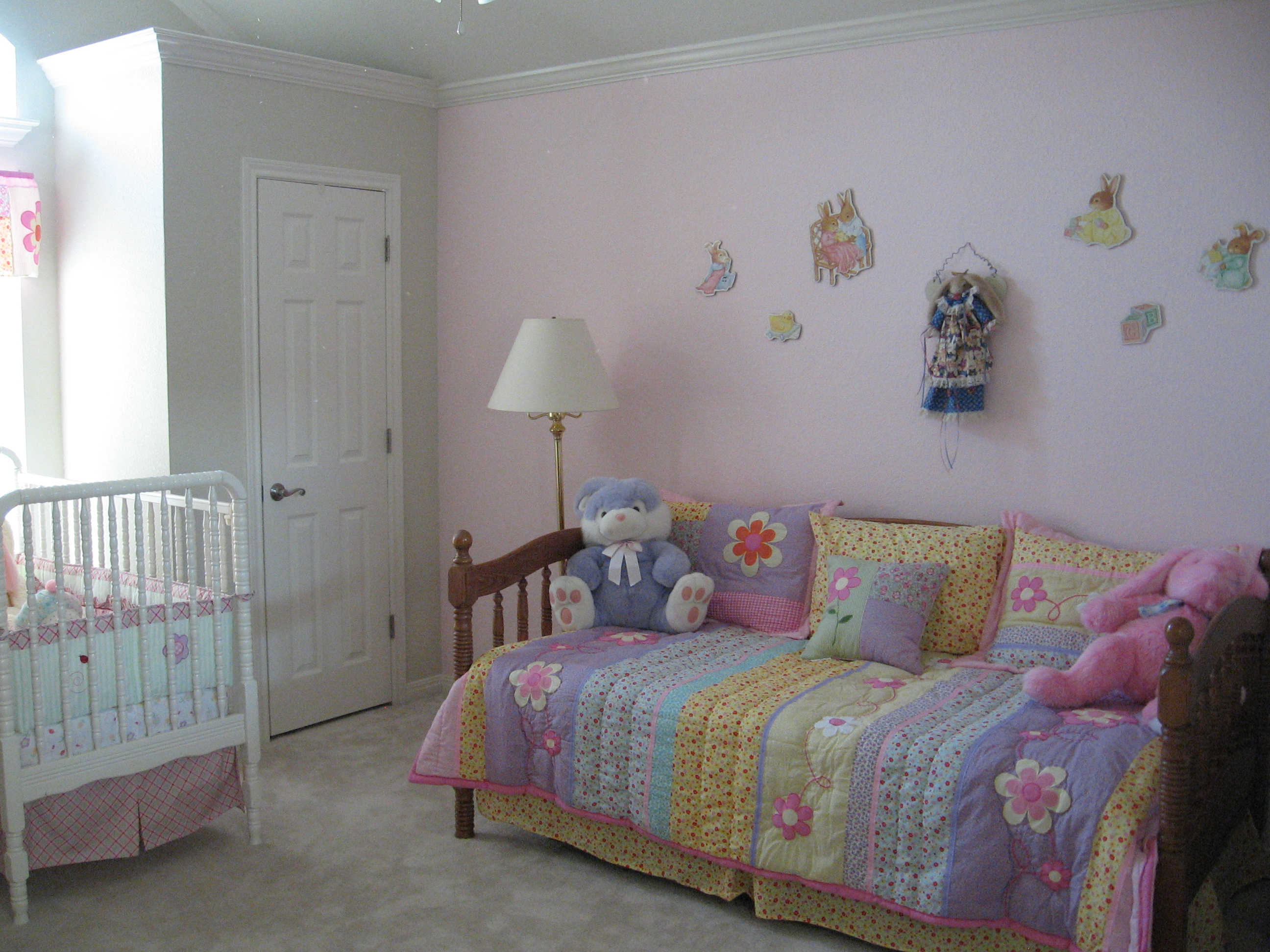
As we excitedly approached our “due date”, my nesting instincts kicked in with lots of preparation for the baby’s room. We purchased a crib, and the baby’s bunny bedroom began taking shape. We were starting from scratch as far as any baby items since this would be my first (non-furry) child.

girls-bunny-bedroom-decorating-ideas

The girl's bunny bedroom that became a boy's sports bedroom

I was certain that my water would break soon after, and that when my daughter finally arrived, she would be approaching her first birthday.

It’s amazing how true that was…except that my daughter would be my rambunctious boy, Stinkpot, that we adopted through foster care!

This week is National Infertility Awareness Week to help others learn the facts about infertility.

If you are suffering from infertility, please browse through this site to read more about how we became parents through the miracle of adoption through foster care.

Also, sign up to receive our e-book detailing how we adopted our second baby through foster care – a true miracle!

9:00 am by Penelope

This 3-Year-Old Needs a Family

This little guy needs a family. His name is Oscar. When I look into his big, brown, engaging eyes, I can’t help but smile.

Isn’t he just adorable?

My kids and I just love chimps!  My fascination with primates began when I wrote my college research paper to question whether they could really communicate with humans using sign language.

Tomorrow, on Friday, April 20th, just in time for Earth Day, DisneyNature is bringing a true story of adoption that actually happened in the wild.

Oscar is a baby chimp born to a caring mother with a huge extended family living in the jungles of Africa.

This film explores how when Oscar suddenly loses his mother, an unexpected member of his clan takes care of him.  Oscar is adopted!

This film demonstrates that, even in nature, foster care and adoption happen.  Some opponents may try to demonize adoption and call for its abolition; however, adoption isn’t evil – sometimes it’s necessary for a little one’s survival in the world – and it can become a beautiful, fulfilling journey.

Can you watch this trailer without feeling a fullness in your throat?

I’m loving the Switchfoot song playing in the trailer: “This is home, now I’m finally where I belong…” We all need to belong.

I’m looking forward to experiencing this film with my boys.  Lil Bit is a bit too young to grasp its message just yet; however, I’m looking forward watching this film with 4-year-old Stinkpot.  At just over an hour (78 minutes), I’m hoping he can sit still that long.

How about you? How do you share stories of adoption with your little ones? What films do you recommend?

10:00 am by Penelope

What Do You Tell Kids About Their Past?


This week, I received a question from a reader that applies to nearly every adoptive family in the foster care community. How much do you share with your children about the reasons they are adopted?

Here is an excerpt from the message I received:

Hi there! We have recently completed our first adoption of a 3-year-old child. They came to us through foster care 10 months ago, and I am trying to find a way to explain to them why they came to be with us… any suggestions? We cannot currently have contact with their birth family for safety reasons, though we want to revisit the possibility as time goes on.

I thought about writing a little book about their story – but how do you remove the age-inappropriate aspects (teen pregnancy, mental illness, drug addiction, suicide, incest, gang life and criminal activity, mafia ties, etc), while still giving them a reason for having had to leave their birth family, and not trivializing it all to the point that when they are old enough to know more they resent you for not being open enough in the past? Big giant question, I know – just hoping for some insight from someone who has adopted a young child through foster care. It’s hard to know what to say.

We are in the same situation with our Stinkpot. This was my reply:

At four years old, I tell Stinkpot about being brought to us by a lady one night & that he cried all that night. I know that his drug-addicted birthmother loved him but just couldn’t kick the habit. When he gets to a point when he might ask, I’m just going to tell him that bio-mom couldn’t take care of him. If pressed, then I would explain how she had some problems that didn’t allow her to take good care of him.  Depending on his age, I will probably use it as a teaching moment about drug abuse when he is old enough to understand it.

Your children are young & as they get older they will probably not remember much so I wouldn’t fret over it too much. Just be supportive & don’t talk badly about their birthfamily. I have a relative with an incarcerated parent that used to say: “I’m a bad person, just like my dad.” Don’t let that happen to your child!

What advice would you give about sharing a child’s traumatic past with them?

I would love to hear from former foster children and what you wanted (or didn’t want) to know?

9:30 am by Penelope

The Gift of an Open Adoption – Even in Foster Care

Never have I struggled so much to compose a blog.  I must have opened and closed my computer 100 times mulling over the angle to take on this topic.  Ironically, that is much like open adoption itself; One thousand different options. Wikipedia quotes an author that nicely explains “Adoption is like marriage. There are countless ways that a marriage can work. What is right for one couple will not work for another. Adoptions are the same.”

So instead of telling you what an open adoption should look like, I am going to tell you about our open adoptions.  I truly believe they are one of the greatest gifts I can give to my kids.

My relationship with our kids’ parents did not start under the best circumstances.  As a foster parent, it was a challenge to form a relationship in the midst of a negative situation. Watching the family interactions, I immediately found “the good” in the parents’ love.  My kids are loved very much by their biological parents.

As our first case progressed, so did my relationship with my son’s parents.  I had a very emotional meeting with his mother where we discussed contact and visits.  His parents were so grateful to know that we would maintain communication that they voluntarily terminated their rights (essentially choosing us to be his parents). We have agreed to annual visits and twice yearly updates, though we have more frequent email communication.  Our first visit went very well.  He looks JUST like his mom, and I love that he will have a relationship with her.

With our second case, the circumstances were a little different.  I wrote our daughter’s mom a heartfelt letter explaining how we loved her, and she would always know she was loved by her mom.  The response was overwhelming.  A gift basket with multiple cards of gratitude, a book stating we had changed her life and a few gifts for our daughter – including a children’s bible.  That simple act of a letter opened up a floodgate and the first show of interest in a relationship.  We will maintain contact through the agency and consider visitation if appropriate in the future.

Ironically, in the middle of this writing, we have come to a necessary decision to move from unsupervised to supervised contact with extended biological family to protect our daughter.  It is a beautiful thing to allow communication and foster the relationship.  It is also important that it is appropriate.  To this, I would just add, when discerning the extent of openness it is important to enact clear boundaries.  I am grateful to have learned this quickly for myself. Err on the side of less and offer more if it seems appropriate down the road.

Ultimately, don’t let fear of open adoption keep you from moving forward.  Everything about adoption is a journey.  It took training, prayer and time for us to embrace the idea.  And it took sitting face to face with a birthmother to get it.  Our family has grown as a result of our openess and we hope our children will always be blessed by this gift.

Elisabeth has desired motherhood since puberty.  She was blessed to meet Mr. Right  & wed in 2002.  The road to parenthood was long, filled with tears & suffering.  In 2007, they were blessed with their miracle “Rosie” thanks to the help of NaPro Technology.  With secondary infertility, Elisabeth & Mr. Right entered the world of foster care.  They adopted “Augie” in 2011 and hope to adopt “Caite” this spring.  Elisabeth is an at home mom, who twilight’s as a FertilityCare Practitioner. Elisabeth blogs at Blessed and Broken.

  • « Previous Page
  • 1
  • …
  • 27
  • 28
  • 29
  • 30
  • 31
  • …
  • 45
  • Next Page »

Looking for something?

Facebook

Foster2Forever

Archives

Why Every Foster Parent Needs Sexual Abuse Training

foster care visitation rules guidelines online

10 Tips for Foster Care Visitation Online

foster-income-taxable

Is Foster Income Taxable? What Foster Parents Should Know About Income Tax

Why Every Foster Parent Needs Sexual Abuse Training

I’m Clever

Sway

Pretty Chic Theme By: Pretty Darn Cute Design