Foster2Forever

  • Home
  • Shop
  • Fostering & Adoption
    • Foster Care
      • Being a Foster Home
      • Birthfamilies
      • Case Workers
      • Concerns
      • Court Hearings
    • Adoption
      • Parenting Tips for After Adoption
      • Benefits
      • Costs
      • Infertility
      • Parental Rights
  • Parenting
    • 31 Tips for Parenting After Adoption
    • Behavior Issues
    • Children’s Activities
    • Family Time
    • Motherhood
  • Our Home Life
    • Cancer & Health
    • Recipes
    • Marriage
    • Family Travel
    • Videos
  • Join Our Community
  • Our Family
  • Contact
  • Privacy Policy

9:00 am by Penelope

Why Back to School Frightens Me

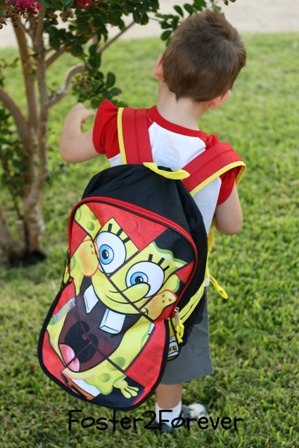
It’s time for BACK TO SCHOOL!!!  And I am anxious – more than a child, I believe. You see, our strong-willed RADish begins Kindergarten soon.

Back to School time is probably not a big deal to most moms – except that sadness to see your little baby walking into big school for the first time.

But this year, for me, Back to School time brings on anxiety and worry about how my little boy (with emotional needs that are tough to understand) is going to handle the pressures of school.

He was kicked out of three day cares for behavior issues. (Yes – Three!!!)  Last year, when he was kicked out of the third day care, we enrolled him in half-day Pre-K while FosterDad and I took turns using FMLA to care for him.

School for only half the day was a good thing for him. He still had a few bad days, but for the most part, a good transition for him. When asked how was school that day, he would reply:

“No time out. No trip to the principal’s office. It was a Good Day!“

However, our child is enrolled in full-day Kindergarten for this upcoming school year.

Lately, especially after having 3 foster children in our home for a few weeks, he has been regressing. Last weekend, for FosterDad’s birthday, we attempted overnight respite. He raged for HOURS after I left him with the caregiver. (He won’t be going back there!)

Is our child ready for BACK TO SCHOOL?

I don’t know! But our backup plan is that if our child isn’t ready for full-day Kindergarten — he can just repeat Pre-K!

Pros:

  • He just turned 5 so a late birthday won’t matter much – He is currently at the 5th percentile for height & hopefully wouldn’t be the smallest in the class
  • He knows the teachers and the teachers know him
  • FosterDad is now retired so he can care for our son half the day

Cons:

  • He is bright so repeating will bore him –
  • With a late birthday for a small boy obsessed with sports, we want hold him back one year but hoping it would be Kindergarten where he would have a stronger curriculum.

We are praying that our child adjusts well this school year.

What are your fears or anxieties about Back to School?

UPDATE: My son had a fabulous year with only one incidence of misbehavior!!!
8:57 am by Penelope

Giving Up the Idea of Ideal

Before being licensed as foster parents, my husband and I were required to complete a training course called Group Preparation and Selection, or GPS. Every Monday night, for 10 weeks, we joined with other prospective foster/adopt parents to learn how the system works, what to expect as foster parents, and how to deal with children who have experienced loss and trauma. The classes were very beneficial and we learned a lot but in foster parenting, like in any other type of parenting, you have to be adaptable.

For instance, in GPS classes we learned that to ease the transition of a move it’s best to have several visits with a child before they move into your home. However, our reality is that 2 of our 3 children that we foster adopted moved in with us on the day they met us. Obviously this is not ideal, but the children were emergency removals. Fortunately, bonding took place very quickly and both children have adjusted very well to our home.

Another thing you learn in your training is that ideally you should build a relationship with your child’s previous foster family, as this builds trust between you and the child and eases their transition into your home. We tried this with both of our daughters’ previous foster families, but were unable to do so with our son’s because of the abuse he suffered from his foster mother. With one daughter, the foster parents didn’t care to maintain contact. We made several efforts to keep them in our daughter’s life yet they made it clear that they just weren’t interested. After only a couple of visits they were done with her whether we liked it or not. With our other daughter we tried to establish a relationship with her foster family, but the former foster mom was so bitter about not being allowed to adopt the child herself (She made some poor decisions that caused her home to be closed as a foster home.) that her self-destructive behavior made subsequent visits out of the question.

However the most surprising difference between what we were taught in GPS training and reality actually is ideal. In the classes you learn about how abuse, neglect, and loss affect children in foster care. You are taught about the stages of grief, creative discipline strategies, and attachment disorders. We were sure that the children placed with us would come with some major emotional baggage. Our first daughter had absolutely no behavioral or emotional issues whatsoever. She was the perfect 3 year old. So perfect in fact that our social workers were quick to warn us not to expect any other foster children to be that way. Our second daughter, easily our most difficult child, has ADHD and was buckwild when we got her. After only a small amount of time in our home we could see a huge improvement and she gets better every day. We are her 8th home, yet she is no more damaged than most other children her age. She is amazingly resilient. Our youngest son has only been with us since last June and already it’s like he’s been with us forever. He’s never had any unusual behavioral problems. He has ADHD and requires a little extra help with his school work, just like many kids who have never been in foster care.

For those of you considering foster care, learn all you can in your classes. Most of it is very valuable information that you will need and use. Just don’t forget that no situation is ideal and that’s ok. All of my children have been ideal, even if their situations didn’t start out that way.

transracial-foster-care-adoptionBecky Johnson is a happy wife and proud mommy of four, both by birth and foster care adoption. Because two of her adoptions have been transracial, her family often gets mistaken for a daycare or church group when out in public. Life in the Johnson home is fun, chaotic, and definitely blessed. Read more about Becky’s family at http://averyblessedmommy.blogspot.com

9:00 am by Penelope

Why Does My Child Act Like This? Could It Be RAD?

We began our foster care journey in the early 80s, and in 1985, we adopted a six-month-old baby girl from foster care, with known exposure to alcohol in utero. She smiled from the moment I saw her. She liked almost everyone at first meeting, and brought them books to read and toys to play with. She climbed into every willing lap she saw. She wasn’t much on cuddling, but as my mother said, “some kids are, some kids aren’t”. Although I didn’t know it then, I had just adopted my first child with Reactive Attachment Disorder (RAD) and FASD (Fetal Alcohol Spectrum Disorder).

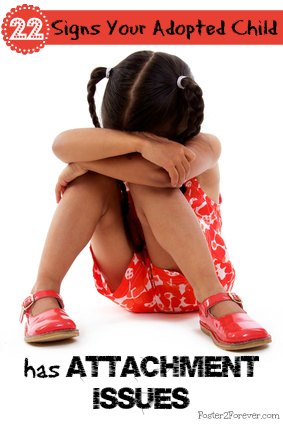
rad-signs-in-children

Types of Attachment

Attachment between a mother and her child is the bond formed between them, and the foundation of all future development. The ideal bond is a Secure Attachment.

An Insecure Attachment occurs when something interferes with the bonding between the mother and child, such as in utero alcohol or drug use, physical abuse, or extreme stress experienced by the mother. Early neglect, physical abuse, sexual abuse, prolonged separation, major illness, or multiple changes in caregivers in a child’s early years can also interfere with a healthy attachment.

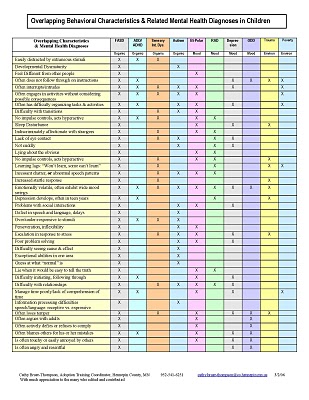
Attachment disorders come in degrees of severity, with the most severe being Reactive Attachment Disorder. Very few children, even those with RAD, have all of the following symptoms. Since a number of the major psychiatric disorders have overlapping symptoms, you should take any child you are concerned about for a full evaluation by a competent psychiatrist.

Overlapping Behavioral Characteristics – Click on the image to see full chart

 Symptoms of Reactive Attachment Disorder

• Superficially engaging & charming • Lack of eye contact on parents terms • Indiscriminately affectionate with strangers • Not affectionate on Parents’ terms (not cuddly) • Destructive to self, others and material things (accident prone) • Cruelty to animals • Lying about the obvious (crazy lying) • Stealing • No impulse controls (frequently acts hyperactive) • Learning Lags • Lack of cause and effect thinking • Lack of conscience • Abnormal eating patterns • Poor peer relationships • Preoccupation with fire • Preoccupation with blood & gore • Persistent nonsense questions & chatter • Inappropriately demanding & clingy • Abnormal speech patterns • Triangulation of adults • False allegations of abuse • Presumptive entitlement issues

Treatment of RAD

Children with attachment disorders who do not receive appropriate interventions frequently develop personality disorders as adults. RAD is the most severe attachment disorder and has the poorest outcome, especially if left untreated.

The younger the child, the less symptoms you are likely to see. We adopted a 4 ¾ year old in August 2010, from a disruption. She is now 6 ½ and diagnosed with RAD. The only two symptoms she doesn’t currently display are preoccupation with fire and preoccupation with blood and gore.

She attends a day treatment program held in one of the local elementary schools. She has therapy three times a week, sees the psychiatrist every two weeks. We recently were approved for waiver services, which gives us 24/7 crisis support, skill-building programs, and respite care.

We encourage eye contact with chocolate, incorporate as much good touch into play as possible, and refuse to allow her to sabotage the big family holidays with her behavior. We are even taking her on a cruise this summer with us, although a friend who is trained in providing respite is coming with us. We are currently looking for an attachment therapist, preferably trained by Dan Hughes in Attachment-Focused Family Therapy.

A child with RAD needs intensive support to heal. We have recently began implementing the “Parenting in SPACE” through Safety, Support, Supervision, Structure, Playfulness, Acceptance, Curiosity and Empathy. We feel that this paradigm gives us the best chance to help our RAD daughter heal. Providing safety, support, supervision, and structure are mandatory. Playfulness, acceptance, curiosity, and empathy are the things that differentiate a family from an institution.

Raising a child with RAD isn’t easy; however, as we see progress in our daughter, we find the rewards.
You can read more about attachment parenting in these books:
Attachment-Focused Parenting: Effective Strategies to Care for Children ,
When Love Is Not Enough: A Guide to Parenting Children with RAD,
The Connected Child : Bring Hope and Healing to Your Adoptive Family, or
Easy to Love but Hard to Raise: Real Parents, Challenging Kids, True Stories.

GBsMom is 55 years old and working on a PhD in Educational Psychology. She has been an adoptive and foster mother for over 30 years. Most of her kids have been some combination of Bipolar, FASD, RAD, ADHD. She has been married for 35 years and is raising her second family, GB, 9, and Hope, 6. She blogs about her life at Adopting Special Needs.

9:00 am by Penelope

Fostering Special Needs – Could You Do It?

We began fostering almost 4 years ago, and I often think about that first checklist we filled out, indicating what type of child we would care for that included race, age, and special needs. I am not sure if any of the children we have fostered have fit  what I thought I could care for. I am so glad that God had a different plan for us.

My journey as a “special needs” foster parent began with our 4th foster placement. I had no idea what I was taking on. He was a “shaken baby” with the possibility of seizures.    I’d had no training on special needs.   While we had him, his health continued to deteriorate. He had a long hospital stay, a feeding tube was placed, and the hospital provided me with all the training I needed.  I think about how God worked in that situation, teaching me every step of the way, as his special needs gradually got greater. It was also during this time that  I learned that our other foster son (now our adopted son) had Fetal Alcohol Syndrome.  That has brought on an entirely different type of parenting, but that is also a lifetime of special needs.

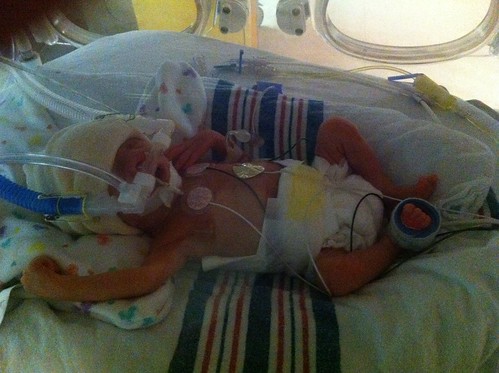
Owen- Special Needs Foster Care

Our foster daughter that we have now also had special needs. I thank God everyday that I was able to learn how to care for her, so that I could confidently say “YES” when they called me to take her. She had already been in 2 placements, and they couldn’t find anyone else to take her that would take on a feeding tube.  She is actually one of the easiest babies I have ever cared for, and we love her dearly.

I had no special training when we were opening our home, our license isn’t different, and most of my training has just come from experience.  The state will adjust their board payment depending on the level of a child’s special needs and the amount of extra care they need (although not automatically, you do have to often ask).  I now see that almost all foster children have “special needs” that you just learn as you go.

As far as medical special needs go, they can often times be easier to care for than behavior challenges. We do have a lot of doctor appointments, so it is nice that I do not have to work outside the home.  I think it is still doable, and your caseworkers can help with this if you do work.  My foster daughter’s biggest challenge is a feeding tube, and once I learned how to do it, it is just as easy as feeding her with a bottle, just different.  Hospitals and doctors will gladly teach someone how to do it.   The medical professionals we have worked with have been so helpful and so grateful to me for caring her her.

So often, my prayers include a prayer of “Thanks” to God for giving me the knowledge to know how to care for her, because she is such a precious little girl.

Special Needs Adoption Through Foster CareMaury has been married for 12 years and has 6 children – biological, adopted, and foster.  She and her husband have been fostering for  years, but her journey began over 5 years when she started working with the Heart Gallery, photographing children waiting to be adopted. She shares her journey at Counting My Blessings.

10:00 am by Penelope

When You Shouldn’t Adopt from Foster Care


This week, renowned adoption advocate, Russell Moore, discussed how not every Christian should adopt:

For years, I’ve called Christian churches and families to our James 1:27 mandate to care for widows and orphans in their distress, to live out the adoption we’ve received in the gospel by adopting and fostering children. At the same time, I’ve maintained that, while every Christian is called to care for orphans and widows, not every Christian is called to adopt or foster. As a matter of fact, there are many who, and I say this emphatically, should not.

He goes on to say:

…every adoption, every orphan, represents a tragedy. Someone was killed, someone left, someone was impoverished, or someone was diseased. Wrapped up in each situation is some kind of hurt, and all that accompanies that. That’s the reason there really is no adoption that is not a “special needs” adoption; you just might not know on the front end what those special needs are.

I certainly agree with this, and even go on to say that every child is a “special needs” child.   Just like us, no child is perfect and will have unique gifts and abilities.

Sometimes parents can throw their expectations onto a child, setting the child to continually be a disappointment when they don’t live up to those expectations.  We all have sinned and fallen short of the glory of God, even parents.  Some parents have unrealistic expectations of how a child should talk, act, and be.  A child’s traits can be positive: strong-willed (determined),  ADHD (energetic), clinginess (affectionate):

…we need Christians ready to care for real orphans, with all the brokenness and risk that comes with it.

If what you like is the idea of a baby who fulfills your needs and meets your expectations, just buy a cat. Decorate the nursery, if you’d like. Dress it up in pink or blue, and take pictures. And be sure to have it declawed.

Dr. Moore has written the book, Adopted for Life: The Priority of Adoption for Christian Families & Churches, a highly regarded book calling Christians to adopt children.  Another purpose of the book is to help equip Christian families going through the process.

I absolutely LOVED this book!!!  What are your thoughts?

  • « Previous Page
  • 1
  • 2

Looking for something?

Facebook

Foster2Forever

Archives

Why Every Foster Parent Needs Sexual Abuse Training

foster care visitation rules guidelines online

10 Tips for Foster Care Visitation Online

foster-income-taxable

Is Foster Income Taxable? What Foster Parents Should Know About Income Tax

Why Every Foster Parent Needs Sexual Abuse Training

I’m Clever

Sway

Pretty Chic Theme By: Pretty Darn Cute Design