Foster2Forever

  • Home
  • Shop
  • Fostering & Adoption
    • Foster Care
      • Being a Foster Home
      • Birthfamilies
      • Case Workers
      • Concerns
      • Court Hearings
    • Adoption
      • Parenting Tips for After Adoption
      • Benefits
      • Costs
      • Infertility
      • Parental Rights
  • Parenting
    • 31 Tips for Parenting After Adoption
    • Behavior Issues
    • Children’s Activities
    • Family Time
    • Motherhood
  • Our Home Life
    • Cancer & Health
    • Recipes
    • Marriage
    • Family Travel
    • Videos
  • Join Our Community
  • Our Family
  • Contact
  • Privacy Policy

8:05 pm by Penelope

How Eye Contact Can Create a Strong Bond with Your Child

One of the best ways to connect with our children (or anyone, in fact) is by making eye contact a habit. Eye contact shows that you value your child. Direct eye contact is beneficial to the child and can help increase the child’s focus and ability to connect with people.

Many times, as a parent, I found myself busy doing something – wrangling babies, cooking dinner, picking up, on the computer, etc. – and my son would say “Mom, you’re not listening to me.”  Since realizing my bad habit and how detrimental that can be to our relationship, I make a concerted effort to STOP and look directly at my son when he is talking to me.

One-on-one full attention with your child cements a parent-child connection that every child needs and deserves.

At-risk children may be uncomfortable with direct eye contact, especially in the beginning. An abused child may even be fearful of eye contact due to previous traumas.  Don’t rush a fearful child into direct eye contact, instead practice for short bits to help the child overcome his fears and earn your trust.  (Also, keep in mind that in many Asian, African, and Latin American cultures, extended eye contact may be viewed as an affront or a challenge of authority.)

  • Move your head so that the child can see your face
  • Stop speaking for a moment to get the child’s attention
  • Use the phrase “Let me see your eyes“

“Never use eye contact as an excuse to give your child a mean or angry stare; instead use your eyes to communicate in a loving and nurturing way.” from The Connected Child: Bring Hope and Healing to Your Adoptive Family (affiliate link)

Great advice on bonding with your child! #adoption

6:30 pm by Penelope

4 Attachment Types To Know Before Becoming a Parent

Attachment can be defined in a number of ways, but can be simply defined as the connection that is developed between a child and caregiver. There are 4 patterns of attachment that a child can develop while being parented, but first…

How is attachment developed?

Attachment is developed through repeated and consistent interactions between a child and caregiver. If this cycle is repeatedly met (doesn’t have to be perfectly met, thank goodness), a child will develop a secure attachment.

 When is attachment formed?

Attachment patterns are developed during the first 12 months of life!

Attachment patterns are usually stable over a person’s lifetime! (The attachment style a person develops as an infant will remain their attachment style as an adult UNLESS the person DELIBERATELY attempts to change that attachment style)

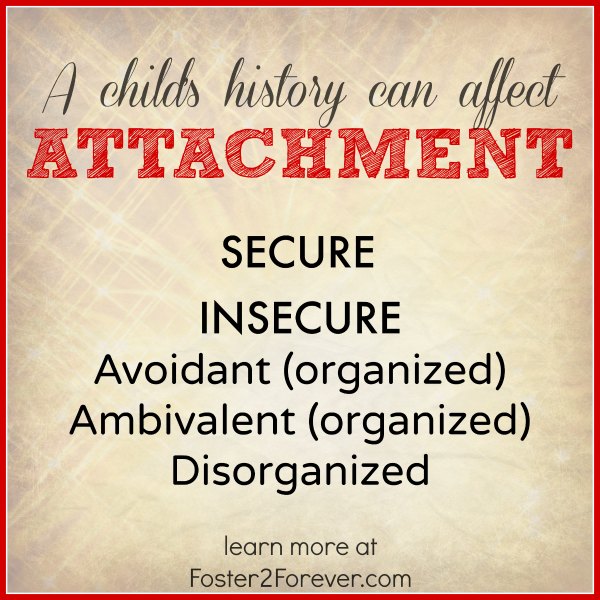
4 ATTACHMENT PARENTING TYPES

  1. Secure
  2. Insecure – Avoidant (Organized)
  3. Insecure – Ambivalent (Organized)
  4. Insecure – Disorganized

A child's behavior can be linked to attachment issues as an infant! #fostercare #adoption

1. SECURE ATTACHMENT TYPE

How is Secure Attachment Developed?

  • Touch, closeness, eye contact – Think of how you hold an infant and look into his face
  • Emotional attunement – Tuning into the internal state of another
  • Secure environment – Feeling safe and cared for
  • Shared pleasure, play, and FUN!

Characteristics of Secure Attachment Type

  • Seeks out caregiver when in need of physical or emotional support or comfort
  • Ability to talk about a wide range of feelings, both positive and negative
  • Feels comfortable exploring new environments while continuing to use their caregiver as a “secure base”
  • Enjoys and is comfortable with physical and emotional closeness
  • Positive beliefs about themselves, others, and the world
  • Emotionally stable (emotional regulation)

2. INSECURE-AVOIDANT ATTACHMENT TYPE

How is Insecure-Avoidant Attachment Developed?

  • The infant is repeatedly NOT soothed
  • The attachment cycle is broken, and the distressed infant stops asking for help
  • The infant is left unattended, in neglectful families or orphanages
  • Sadly, the infant still produces stress hormones, yet doesn’t act stressed
  • The infant learns not to depend on anyone to soothe or meet his needs

Characteristics of Insecure-Avoidant Attachment Type

  • Emotionally distant and aloof
  • Limited tolerance for feelings
  • Inflated self-reliance to minimize need for connection
  • Independent or inappropriately mature
  • Lacks empathy
  • The child’s solution is limited dependence on relationships. Take care of self. Deny or avoid feelings or emotions.

3. INSECURE-AMBIVALENT ATTACHMENT TYPE

How is Insecure-Ambivalent Attachment Developed?

  • The distressed infant sometimes has his needs met
  • The caregiver is inconsistent (due to their own unresolved attachment histories, or could be due to substance abuse or mental illness)
  • Disruptions is care due to inconsistent or chaotic caregiving (also displacements via foster care)

Characteristics of Insecure-Ambivalent Attachment Type

  • Crave attachment yet pushes away (push/pull behaviors)
  • Clinginess (bottomless pit)
  • Unable to self-soothe (as they get older) and need all soothing from an outside source
  • Fear of abandonment
  • The child’s solution is to keep caregivers in constant proximity

4. DISORGANIZED ATTACHMENT TYPE

How is Disorganized Attachment Developed?

  • Caregiver is frightening, dangerous, or causes terror
  • Child needs the caregiver for survival but is terrified of the caregiver
  • Child cannot find a solution which results in disorganized attachment

Characteristics of Disorganized Attachment Type

  • Significant difficulty with behavior, emotions, attention, and relationships
  • Attempts to control their caregiver in order to make them more predictable
  • Prone to dissociation
  • 80% of abused children have disorganized attachment (Siegel)

To learn more about attachment and how your parenting can affect your child’s attachment, you can read Parenting from the Inside Out: How a Deeper Self-Understanding Can Help You Raise Children Who Thrive by Dan Siegel (Amazon affiliate link).

9:00 am by Penelope

I’m Treating my Kindergartner Like a Baby – And It’s Working

For those of you with children that may have Reactive Attachment Disorder (RAD) or other attachment issues, you can understand the disruption it causes in your family. The sheer exhaustion of it all.

Many times I am overwhelmed by the reaction that my child has sometimes. And nothing seems to work. However, after so many of you recommended it, I finally began reading The Connected Child: Bring hope and healing to your adoptive familyby Dr. Karyn Purvis of TCU.  (Read about Feeling Hopeless from Chapter 1. Are you reading along?)

Chapter 2 of The Connected Child is “Where Your Child Began” and describes all the sensory input your adopted child may have missed to be able to form normal attachments in life. Chapter 2 of the companion study guide, Created to Connect, focuses on feeling compassion for your child.  I do feel compassion for my child – I love him – but sometimes when he turns into possessed devil-child, I just want to lay down the strict law to get his little butt to straighten up!

However, there was one small sentence in the book that hit me: “Your job, as parents, is to help these children get what they missed…” Then the study guide expanded on this concept about “Returning to the Beginning” discussing how children may actually be required to “go backwards” in order to move forward. When I read the illustration about the older adoptee wanting hot tea with her mom many times a day and her mom’s comparison to bottles and sippy cups, it struck a chord with me.

Although we received our child as an 8-month-old foster baby, do we need to somehow go backward and makeup for those first 8 months of neglect?

One night, our child had another horrible episode. He wanted to go outside and play football but was refusing to eat supper. He even attempted to throw his plate across the room. FosterDad was clearly in discipline mode.  I intervened with another approach.

reactive-attachment-disorder-therapy

As I scooped my little one up in my lap, he first fought me, but in a soft baby-toned voice, I began saying: “Oh! My little baby needs to eat supper, but this food is for big kids. Let’s mash this up and put a bib on this baby! Oh, here’s a bite. Open wide, baby…”

Would you believe, he began playing like he was a baby and anxiously took bite after bite until he was done?  Then he got down and went outside to throw the football with Daddy.

Whoa! Crazy, huh? But it worked!

Then the next night again, he was throwing a fit about wanting some candy, but we had Pediasure for him to drink. I picked up the squirt bottle it was in, acting like it was a bottle, and put my child in my lap in the rocking chair. “Oh, look at this baby needing his bottle!”  He drank it quickly and the evening went well after all that drama.

This is nuts! But it’s working!

Now, I don’t want my child ruling the roost, so to speak, but by “going backwards”, he is getting something that he missed, and we, as parents, are getting him to mind (in a weird kind of way).  Is this approach the right approach?  Who knows?

There will be someone that will criticize me for “giving in” to his fits, but it’s working right now for our family right now.

Hopefully, I won’t be picking him up and treating him like a baby when he’s a teenager – THAT would be awkward!

Are you reading The Connected Child along with me? What may your child have missed? How can you go backwards to help heal your child?

7:56 am by Penelope

My Struggle with Attachment Disorder

toddler-tantrum-foster-child-trauma-bonding-attachmentHe was out-of control – as if demons had taken over his soul. His screaming was unintelligible. His body was flailing about with his arms punching the air or anything in the way. His face was the color of a sun-ripened tomato. His kicking jerked as his body contorted into different directions.

This wasn’t just a tantrum.

My role as a mother is to raise my precious preschooler into a Godly man. But my doubts overwhelm me during these moments. Had Satan already taken hostage of my child through a disorder known as Reactive Attachment Disorder or RAD?

In these moments, I am broken. I fall to my knees crying out for God to release the demon from my beloved child.

Through the prayers, God is awakening me to devote myself to this child.

Whatever it takes, dear Lord!

My child has emotions from his neglected infanthood that he cannot understand or control. His desire is to have all his physical needs met and feel that unconditional love.

As his mother, I have to make sacrifices. I’ve taken him out of full-day school. I’ve taken family leave from work to demonstrate to him that Mommy loves him and wants to be with him.

I devote my life to my son.

A problem that isn’t too large for my Lord and Savior.

Have you liked Foster2Forever’s Facebook page?

7:20 am by Penelope

My Struggle with Parenting a Difficult Child

Last month, I discovered attachment parenting.  I wrote about the benefits of babywearing for attachment, which is especially beneficial for our neglected and traumatized children.  After my research, I felt like I missed the boat with my Stinkpot, brought to us at 8-months-old and severely neglected. I regret not “wearing” him or taking leave from work, as I am doing now.  (Other aspects of attachment parenting, such as breastfeeding and co-sleeping, aren’t viable options for foster parents.)

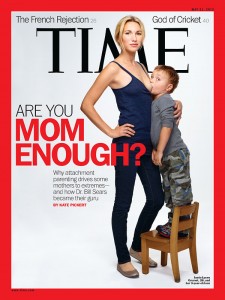
However, this week, Time Magazine highlighted the extreme of attachment parenting with a controversial cover photo showing a mother breastfeeding her large 3-year-old son as they both glared at the camera defiantly.

I have to agree with adoption advocate, Kristen of Rage Against the Minivan, when she wrote about Mommy Wars and the Motherless Child:

I don’t much care if you breastfed your kid until they started kindergarten, or if you fed them formula from day one. I don’t really care if you turned your infant car-seat forward-facing prior to age 2, or if you homeschool, or if you send your kids to daycare while you go to work. Do you cosleep? Did you circumcise your son? I DON’T CARE.  Do you babywear? Push your kid around in a stroller? Use a leash for your kid at Disneyland?  Whatever.  Good for you.

As long as it isn’t abusive or neglectful, how someone chooses to parent their child is really none of my business.  To each his own!

However, after watching this interview on the Today Show, I began to think about our future generation, and my own struggles to parent a difficult child. Is attachment parenting really that great for our kids?

Did you notice in the interview that the mom stopped during the nationally-televised live broadcast to address her son’s whining?  Whoa!  Is that how we should parent our children? Stopping our world to deal with our children’s demands whenever they wish?

I struggle with parenting a difficult, demanding 4-year-old child. He interrupts and throws fits.  He demands that I watch him play and even go to the potty. I want him to overcome his issues with abandonment through attachment, yet I do want my child to become a self-reliant adult.

My biggest problem with the concept of attachment parenting (excluding the babywearing which I regret not doing) is that a child may learn that the world revolves around him.  And this is difficult for me since my little one didn’t have his very basic needs met as an infant.  My poor baby would cry out to the world in pain from a wet diaper that would hurt his bottom covered with sores from a diaper rash – and nobody came to comfort or change him. (My heart aches as I write this.)

I want my Stinkpot to know that he will get his needs met. He will have something to eat when he is hungry, but he has to learn that it won’t be cheesy chips or honey buns. Throwing a fit won’t change that.

As parents, we have to teach our children to soothe themselves and delay their immediate gratification if they are going to become self-sufficient adults.  Lessons such as learning to not spend money as soon as they get it and save for a car, etc.  Due to his ADHD, my Stinkpot struggles with impulsiveness.  I want to teach him about delaying his immediate gratification for something bigger. And it’s a tough lesson to teach to any child, much less one with a disability.

As my Stinkpot begins school, he is learning that he has to be a part of a class which more than himself.  A tough lesson for him.

Parenting is tough. And there is no one right way to do it. As parents, we have to just do the best we can and learn as we go along.  That’s why it’s called the journey of motherhood.

How do you balance all the different parenting advice to find your own unique style that fits your family?

9:00 am by Penelope

Why Does My Child Act Like This? Could It Be RAD?

We began our foster care journey in the early 80s, and in 1985, we adopted a six-month-old baby girl from foster care, with known exposure to alcohol in utero. She smiled from the moment I saw her. She liked almost everyone at first meeting, and brought them books to read and toys to play with. She climbed into every willing lap she saw. She wasn’t much on cuddling, but as my mother said, “some kids are, some kids aren’t”. Although I didn’t know it then, I had just adopted my first child with Reactive Attachment Disorder (RAD) and FASD (Fetal Alcohol Spectrum Disorder).

rad-signs-in-children

Types of Attachment

Attachment between a mother and her child is the bond formed between them, and the foundation of all future development. The ideal bond is a Secure Attachment.

An Insecure Attachment occurs when something interferes with the bonding between the mother and child, such as in utero alcohol or drug use, physical abuse, or extreme stress experienced by the mother. Early neglect, physical abuse, sexual abuse, prolonged separation, major illness, or multiple changes in caregivers in a child’s early years can also interfere with a healthy attachment.

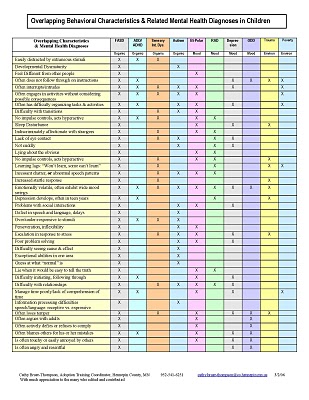
Attachment disorders come in degrees of severity, with the most severe being Reactive Attachment Disorder. Very few children, even those with RAD, have all of the following symptoms. Since a number of the major psychiatric disorders have overlapping symptoms, you should take any child you are concerned about for a full evaluation by a competent psychiatrist.

Overlapping Behavioral Characteristics – Click on the image to see full chart

 Symptoms of Reactive Attachment Disorder

• Superficially engaging & charming • Lack of eye contact on parents terms • Indiscriminately affectionate with strangers • Not affectionate on Parents’ terms (not cuddly) • Destructive to self, others and material things (accident prone) • Cruelty to animals • Lying about the obvious (crazy lying) • Stealing • No impulse controls (frequently acts hyperactive) • Learning Lags • Lack of cause and effect thinking • Lack of conscience • Abnormal eating patterns • Poor peer relationships • Preoccupation with fire • Preoccupation with blood & gore • Persistent nonsense questions & chatter • Inappropriately demanding & clingy • Abnormal speech patterns • Triangulation of adults • False allegations of abuse • Presumptive entitlement issues

Treatment of RAD

Children with attachment disorders who do not receive appropriate interventions frequently develop personality disorders as adults. RAD is the most severe attachment disorder and has the poorest outcome, especially if left untreated.

The younger the child, the less symptoms you are likely to see. We adopted a 4 ¾ year old in August 2010, from a disruption. She is now 6 ½ and diagnosed with RAD. The only two symptoms she doesn’t currently display are preoccupation with fire and preoccupation with blood and gore.

She attends a day treatment program held in one of the local elementary schools. She has therapy three times a week, sees the psychiatrist every two weeks. We recently were approved for waiver services, which gives us 24/7 crisis support, skill-building programs, and respite care.

We encourage eye contact with chocolate, incorporate as much good touch into play as possible, and refuse to allow her to sabotage the big family holidays with her behavior. We are even taking her on a cruise this summer with us, although a friend who is trained in providing respite is coming with us. We are currently looking for an attachment therapist, preferably trained by Dan Hughes in Attachment-Focused Family Therapy.

A child with RAD needs intensive support to heal. We have recently began implementing the “Parenting in SPACE” through Safety, Support, Supervision, Structure, Playfulness, Acceptance, Curiosity and Empathy. We feel that this paradigm gives us the best chance to help our RAD daughter heal. Providing safety, support, supervision, and structure are mandatory. Playfulness, acceptance, curiosity, and empathy are the things that differentiate a family from an institution.

Raising a child with RAD isn’t easy; however, as we see progress in our daughter, we find the rewards.
You can read more about attachment parenting in these books:
Attachment-Focused Parenting: Effective Strategies to Care for Children ,
When Love Is Not Enough: A Guide to Parenting Children with RAD,
The Connected Child : Bring Hope and Healing to Your Adoptive Family, or
Easy to Love but Hard to Raise: Real Parents, Challenging Kids, True Stories.

GBsMom is 55 years old and working on a PhD in Educational Psychology. She has been an adoptive and foster mother for over 30 years. Most of her kids have been some combination of Bipolar, FASD, RAD, ADHD. She has been married for 35 years and is raising her second family, GB, 9, and Hope, 6. She blogs about her life at Adopting Special Needs.

9:00 am by Penelope

Can You Stay Home with Your Foster Children?

Because of his explosive behavior, our son had gotten kicked out of his second daycare before Christmas 2010. He was only 3 years old!

I had ignored my rights under the Family and Medical Leave Act (FMLA) and not taken time off work when he was first placed with our family in March 2008 or for his adoption the next year; but I wouldn’t again! So last spring, I took family leave to spend more time with my 4-year-old. My little boy needed his mommy!

I enrolled him in a couple of Mother’s Day Out programs, working part-time, giving me the ability to extend my 12-week leave throughout the spring until school was out when he could stay home with FosterDad (a teacher). I continued working to ensure our medical insurance would be paid.

Our son improved tremendously! No melt-downs or tantrums at MDO the entire spring or summer!!! (I wish I could say the same for at home)

Last fall, thinking a year at home had helped him, we were excited to enroll our son into highly-regarded daycare/preschool in our area. He had been on the wait list for two years!

At 4-years-old, he seemed ready. And he was — for only about 8 weeks; the stress of all-day care finally caught up with him. His explosions were worse! More out-of-control than ever!

We had to do something! We made the difficult decision to try psychotropic medications. His explosions continued.

We knew by experience that his time at this preschool was limited. FosterDad quickly found a place in the Pre-K class at the public school where he taught. My stomach was in knots. We were not solving the problem, just transferring the problem somewhere else. I knew in my heart it wasn’t the right thing to do. I needed to leave my job to stay home with my son.

Then, while at work on the morning of November 10, 2011, I was silently crying and praying when I received an email from one of God’s messengers.

A person from Human Resources had written to ask me if the time I had taken off the week before was FMLA. What?!

My fingers raced to place a call.

“Didn’t I use up all my FMLA hours?”

“No?” I was still eligible for over 100 hours of FMLA that didn’t expire until the end of January!

I was overwhelmed by God’s hand on me that morning.

My Facebook post that day read: “When feeling down and confused, blessings from above can make you soar above the clouds! Thank you, Lord, for your unexpected blessings!”

I never shared that with you since we were busy with Adoption Day preparations and trying to decide whether to add Lil Bit’s newborn sibling to our family.

I enrolled him in the half-day Pre-K at the local elementary school, and began picking him up for lunch every day.

JD was excited about going to “big school” where the neighborhood kids attend.

FosterDad began full-time family leave in February, and goes back to school today – for one month until school is out – then he retires June 1st!

Not that our son hasn’t had a couple meltdowns at the new school. (Fortunately, public schools can’t kick kids out for bad behavior) But he has adjusted and is doing much better.

Our son even won an award at school! Okay, full disclosure, it was a perfect attendance award, but we are proud of him, nonetheless.

I’ve reapplied for FMLA for the month of May – So today, I’m excited to begin my time off with my little boy! There’s nothing like Mommy and Me time!!!

9:00 am by Penelope

Babywearing: A Different Way to Form Attachment?

Promoting attachment and bonding with our traumatized little ones can certainly be a challenge. When Maura of Fostering Awareness wrote about babywearing, my redneck response was: “Babywearing? What in the tarnation is that?”

babywearing-benefits-attachment-parenting

Babywearing is one of the principles of attachment parenting taught by renowned pediatrician, Dr. Sears, to foster a secure attachment between an infant and caregiver.

WOW! I had only seen baby carriers as just another way to transport your baby, not as a means of attachment.

I had a baby carrier for Stinkpot for a very short time and used it only on rare occasions.

Could “wearing” our severely-neglected 8-month-old Stinkpot have helped with his attachment issues?  Would wearing him more have helped him attach more?

As with any parenting method, there are pros and cons of babywearing – and, of course, everyone has an opinion. What’s yours?

How has babywearing affected attachment and bonding with your traumatized little ones?

To read more on attachment parenting (Amazon affiliate links):
Here’s a highly rated Kindle book:  Attached at the Heart: 8 Proven Parenting Principles for Raising Connected and Compassionate Children
Dr. Sears’ book:  The Attachment Parenting Book: A Commonsense Guide to Understanding and Nurturing Your Baby

CHECK OUT THIS HIGHLY-RECOMMENDED BABY CARRIER

10:51 am by Penelope

Guest Post: Letting Go When Foster Children Leave

Two of foster care placements were especially hard on our family. One was our first placement, a baby girl just two days old who was with our family for 5 ½ months. The other was our third placement and our longest to date at nine months. He was placed with us at 4 days old. He is going home today. To say that those wounds are fresh would be an understatement. Saying goodbye is not easy for me. Sure bonding comes with each child at their own time. One of my favorite posts is by Noisy. Colorful. Livel. “Attachment, where’s the Velcro when you need it.” With these little ones, the newborn babes, bonding is effortless for me. Give me a baby to hold in my arms and they are mine. Loved! Adored!

When we first started foster care we thought that adoption would come up at some point. That eventually we would adopt and we were happy when that day came. We had a young son in the home and weren’t too anxious to have any permanent newcomer. Oh, what a difference a day can make. From the moment these little ones were in our home I did not want to let them go. However, when you sign up as a foster parent, you sign up to support family reunification first. So of course that day came when I was forced to let go.goodbye-foster-children

In the case of our first placement, Little Miss, she wasn’t returned home. Instead a local Native American tribe took jurisdiction on the case since her birth mother had enrolled with them just after giving birth. Under the ICWA laws I did not have first choice after family was ruled out because I do not have any considerable Native American history. Her loss was devastating to say the least. I remember crying my eyes out after she left. I also remember feeling completely normal and putting those feelings of grief aside. It wasn’t until later when another Native American little girl was placed with us that those feelings of loss crept up and overwhelmed me. It is completely normal to feel the different stages of loss. It is important to validate your feelings and talk about them.

Little Dude, who is the baby who is going home today, was placed with me the day after I found out I was losing Little Miss. In some ways I had hope that he was some blessing from on high. A way to make up for the loss of our sweet baby girl. His case has been up and down. There were times I was certain adoption would happen. I prayed it would. Hope kept being drawn-out as extensions in the case were granted. However, all concerns with his biological family were resolved and he was able to return to his father. I am still in shock. Letting go is not easy. But I do know that it is possible. That I can love again.

Foster parenting is incredibly rewarding and, honestly, I wouldn’t trade these experiences. I am growing so much as a person – and more importantly as a Mother.

You can read all about Foster Mama’s foster care and adoption adventures over at:  Foster Mama & the kiddos.  She and her husband have been foster parents for just over a year and in that time have had five placements. Sadly, they have said goodbye to four of them.

  • « Previous Page
  • 1
  • 2
  • 3
  • Next Page »

Looking for something?

Facebook

Foster2Forever

Archives

Why Every Foster Parent Needs Sexual Abuse Training

foster care visitation rules guidelines online

10 Tips for Foster Care Visitation Online

foster-income-taxable

Is Foster Income Taxable? What Foster Parents Should Know About Income Tax

Why Every Foster Parent Needs Sexual Abuse Training

I’m Clever

Sway

Pretty Chic Theme By: Pretty Darn Cute Design