Foster2Forever

  • Home
  • Shop
  • Fostering & Adoption
    • Foster Care
      • Being a Foster Home
      • Birthfamilies
      • Case Workers
      • Concerns
      • Court Hearings
    • Adoption
      • Parenting Tips for After Adoption
      • Benefits
      • Costs
      • Infertility
      • Parental Rights
  • Parenting
    • 31 Tips for Parenting After Adoption
    • Behavior Issues
    • Children’s Activities
    • Family Time
    • Motherhood
  • Our Home Life
    • Cancer & Health
    • Recipes
    • Marriage
    • Family Travel
    • Videos
  • Join Our Community
  • Our Family
  • Contact
  • Privacy Policy

3:10 pm by Penelope

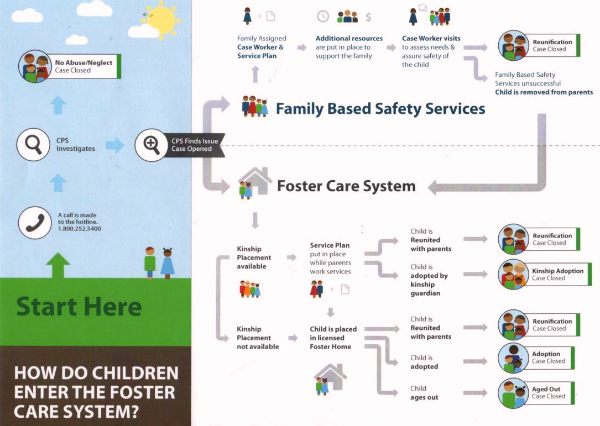
How Children Enter the Foster Care System

As a foster parent, I have never been privy to the removal of a child placed in foster care. The process after a child enters foster care is quite complicated and can have a number of outcomes.
how-children-enter-foster-care-system

Before a child enter the foster care system, an investigation is conducted by the state investigators. If the investigator finds no reason to believe that a child is abused or neglected, the case is closed.

However, if CPS finds an issue, the case is either referred to Family Based Safety Services or the child enters the Foster Care system.

Family Based Safety Services is used when there is a safety issue that puts a child at risk. FBSS is meant to help families stay together. A caseworker is assigned and a Family Service Plan is developed to address each of the safety issues discovered to keep the child safe. Family Service Plans may include parenting classes, drug treatment plans, drug testing, psychological evaluations, individual and family counseling, and other services to get the family back on track. The caseworker continues to visit and evaluate the safety of children in the home.

If the family completes the family services plan, then the case is closed. However, if the parents do not complete their family services plan, then a child enters the foster care system.

The priority is to place a child with a relative in kinship care; however, if no suitable relative is found, then the child is placed in a licensed foster home.

While the child is in foster care, the parents still have the opportunity to complete family services and the child can be reunified with the parents. However, if the parents do not complete services, the child can be either adopted or age out of the foster care system.

10:00 am by Penelope

Will Your Smoke Detectors Pass a Fire Inspection?

Do you have enough smoke detectors to pass your fire inspection?

When we were seeking our license to become foster parents, one of the requirements is to pass a “FIRE INSPECTION.”  Fortunately, Texas lays out the requirements directly in the foster home and State Fire Marshal rules.

However, many states don’t specify the requirements for smoke detectors — you have to rely on finding these yourself or scheduling the fire inspection only to discover that you need another smoke detector.

Here are the requirements for smoke detectors to pass a fire inspection in all 50 states. Great resource for licensing foster homes.

For a fire inspection, the State of Texas requires working smoke detectors:

  • In every sleeping room;
  • In the hallway near sleeping rooms;
  • At the top of stairs in two-story homes (in addition to sleeping rooms).

The State Fire Marshal rules also state:

“Batteries shall be changed at least annually. Statistics show about one-third of the smoke detectors installed in homes are inoperative. When detectors are non-operational, the usual reason is dead or missing batteries.”

You can find other state fire marshal requirements for smoke detectors here. 

Energizer®, in partnership with the International Association of Fire Chiefs (IAFC), strives to keep families safe through the Change Your Clock Change Your Battery® program (CYCCYB).  

Households with non-working smoke alarms now outnumber those with no smoke alarms. (mostly due to dead batteries)

On Daylight Savings Time when you are already changing your clocks in your home — be sure to change and test the batteries in all your smoke and carbon monoxide detectors.

Do you have the required number of smoke detectors for your home?

6:10 am by Penelope

What Are the Rules for Swimming With Foster Kids?

Swimming (and playing in the water) is the number one recreational activity in the summer!  However, according to the Centers for Disease Control (CDC), one in five people who drown are children age 14 and under! [CDC]

A licensed foster home has rules and regulations to follow in regard to water safety for foster children.

These rules for foster families are actually practical water safety tips that ANY family with children should implement.

pool-rules-regulations-foster-children

Who has to abide by these water safety requirements for swimming pools & water bodies?

These requirements only apply to homes that are providing foster care services. This includes foster homes also approved as adoptive homes, but does not include adoptive homes only approved for adoption.

What are the general requirements for caregivers regarding water safety for foster children?

  • Caregivers must use prudent judgment and ensure children in your care are protected from unsupervised access to water such as a swimming pool, hot tub, fountain, pond, lake, creek, or other body of water.
  • If children are allowed to swim in a body of water such as a river, creek, pond, or lake, the supervising adult must clearly designate swimming areas.
  • Rules governing the activity and the dangers of the body of water must be explained to foster children in a manner that is clearly understood prior to their participation.

What are the child/adult ratios for swimming activities?

The maximum number of children one adult can supervise during swimming activities is based on the age of the youngest child in the group and is specified in the following chart:

If the age of the youngest child is…

Then you must have one adult to supervise every (number) child/ren in the group

Swimming

Child/Adult Ratio


0 to 23 months old

1

1:1

2 years old

2

2:1

3 years old

3

3:1

4 years old

4

4:1

5 years old or older

6

6:1

  • If four or more children are engaged in swimming activities, then there must be at least two adults to supervise the children.
  • A lifeguard who is supervising the area where the children are swimming may be counted in the child/adult ratio.
  • Children over the age of 12 years old who are proficient swimmers do not have to be included in the ratio.

Do all supervising adults have to know how to swim?

No. However, at least one adult counted in the swimming child/adult ratio must be able to swim, carry out a water rescue, and be prepared to do so in an emergency.


When must a child wear a life jacket?

A child must wear a life jacket when:

  • Participating in boating activities;
  • The child is in more than two feet of water and does not know how to swim; or
  • Ordered by a physician for a child with a medical problem or disability.

What are the general requirements for a swimming pool at a foster home?

  • The caregivers must inform children about house rules for use of the swimming pool and appropriate safety precautions. Adult supervision and monitoring of safety features must be adequate to protect children from unsupervised access to the pool.
  • At least two life-saving devices must be available, such as a reach pole, backboard, buoy, or a safety throw bag with a brightly colored buoyant rope or throw line. One additional life-saving device must be available for each 2,000 square feet of water surface, so a pool of 2,000 square feet would require three life saving devices.
  • Drain grates must be in place, in good repair, and capable of being removed only with tools.
  • Caregivers must be able to clearly see all parts of the swimming area when supervising activity.
  • The bottom of the pool must be visible at all times.
  • Pool covers must be completely removed prior to pool use.
  • An adult must be present who is able to immediately turn off the pump and filtering system when any child is in the pool.
  • Pool chemicals and pumps must be inaccessible to all children.
  • Machinery rooms must be locked to keep children out.

What are the requirements for accessibility and fences around swimming pools?

  • A fence or wall that is at least four feet high must enclose the pool area.
  • Fence gates leading to the outdoor pool area must be self-closing and self-latching.
  • Gates must be locked when the pool is not in use.
  • Keys to open the gate must not be accessible to children under the age of 16 years old.
  • Doors that lead from the home to the pool area must have a lock that only adults or children over 10 years old can reach. The lock must be completely out of the reach of children younger than 10 years old.
  • Furniture, equipment, or large materials must not be close enough to the pool area for a child to use them to scale the fence or release a lock.

Are the requirements different for aboveground pools?

 An aboveground pool must:

  • Be inaccessible to children under the age of 16 years old when it is not in use.
  • Meet the same requirements for swimming pools, but is not required to be fenced.

Does a backyard fence meet these requirements for inaccessibility?

A backyard fence may serve as the pool fence/wall if it meets all fence/wall and gate criteria above that requires that children may not have unsupervised access to the pool area. Therefore, if the backyard fence serves as the pool fence/wall, then children may not have unsupervised access to the backyard and doors leading to the back yard must comply with the requirements. However, if the entire backyard is serving as the pool area, children may not be in the backyard without direct caregiver supervision.


What are the safety requirements for a hot tub?

A hot tub must be:

  • Enclosed per the requirements above; or
  • Covered with a locking cover when not in use.

What are the safety requirements for wading pools?

Wading/splashing pools (less than two feet of water) must be:

  •  Stored out of children’s reach, when not in use;
  •  Drained at least daily; and
  •  Stored, so it does not hold water.

What if there is a body of water that is on or adjacent and accessible to a foster home?

You must document the following regarding a body of water that is on or adjacent and accessible to the premises of a foster home:

  • Type, location, and size of the body of water; and
  • Barriers between the foster home and the body of water.

Note: This list of water safety rules is for foster homes in the State of Texas. You can read more of the Texas regulations for foster homes or check with your state foster home licensing agency.

How do you keep your children safe around water?

7:00 am by Penelope

The Kids that Couldn’t Come, then Could, then Didn’t

If you follow on Facebook and Twitter, you know that we almost had some placements last Thursday.

The situation was that a sibling group of 5 needed short-term emergency placement. Because it is nearly impossible to find foster homes available to take 5 children, the State was having to split the siblings into 2 homes. The call we received was for 3 children.

Since 20-year-old Bubba recently moved back home, we currently only have 2 beds available, and that includes the trundle. So sadly, we couldn’t accept the placements.

Then, a few minutes later, the State called back: “Could you take a sibling group of 2?”

“Yes, we can!”

We were excited that Stinkpot would have some older “siblings” to play with this summer.

However, after that conversation, the State called back a third time.
“We’ve found a foster home for the kids in their home county.”

These children will be able to have visits with their siblings easier.

The question of how many foster children you can have in your home, lead to over 20 comments on Facebook.

Siblings available for adoption. Click photo for more details.

These are the capacity requirements for foster family homes in Texas:

“The State of Texas allows no more than 6 children in the home including your own children or children for whom you provide day care.”

A two-parent foster family home may care for up to six children, including any biological and adopted children of the caregivers who live in the foster home and any children receiving foster or respite child-care, and children for whom the family provides day care.

If a licensed foster home has one foster parent that is absent for extended periods, such as military service or out-of-town job assignments, the home must comply with single-parent foster home requirements when only one foster parent is regularly present in the home.

A single-parent foster family home may care for a maximum of:
(1) Five children if any child in the home is under five years old;
(2) Four children if more than two children in the home receive treatment services; and
(3) Four children if any child in the home receives treatment services for primary medical needs.

How many children does your state allow you to have in your home???

9:00 am by Penelope

Lil Bit’s Baby Brother – Isn’t He More than Just a Check?

If you follow on Facebook and Twitter, you know that we had the incredible blessing of meeting Lil Bit’s precious 4-month-old baby brother this weekend! Remember him? Remember 2 days before Lil Bit’s adoption, we received a placement call to foster this newborn brother being released from the hospital?

A decision that tore me up inside when we declined.  Worry consumed me until we discovered that Baby Brother had been placed in a home anxiously awaiting an infant for adoptive placement.

This weekend, we inadvertently enrolled in the same training class with Baby Brother’s foster mom.  Baby Brother looks like his older brother – and just as cuddly and sweet.  He is blessed to have a family that loves him.

However, our boys have half-siblings that aren’t as lucky.  Those other siblings were placed with a “friend” of the birthmother.  Remember the Cons, that were determined to take Lil Bit, since all it would cost them was a “shiny, new cell phone.”  Still determined to add to their “family”, they have been wining & dining birthmom at the Golden Corral.

All the previous children have been labeled as “disabled” so that the Cons can demand larger subsidy checks. The children are all encouraged to perform poorly in school.  It breaks my heart for these children that can only live up to their “disability”.

During our case, CPS adamantly opposed placement with the Cons; however, they flip-flopped their position in Baby Brother’s case.

The CPS policy of “family first” had them attempting multiple times to remove Baby Brother from a loving home to a placement with his half-siblings. Even though his half-siblings are in an uncaring environment, used only for a check.

The good news is that Baby Brother is staying put – TPR is complete – and adoption is the plan.

And the other big news is…

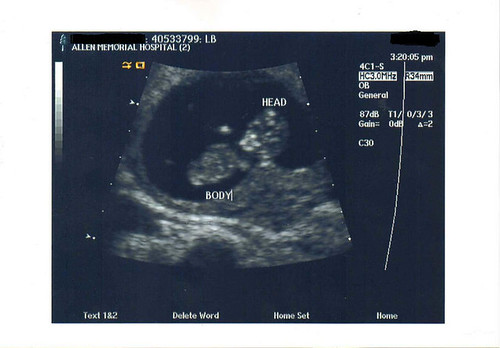
ultrasound

Not me….Birthmother….again!!!

9:00 am by Penelope

This is How Inefficient our Government Really Is

Have you read this book written by a former foster child?


We were so excited to finally adopt our Lil Bit! Now, over two months later, we are still anxiously awaiting the arrival of his new birth certificate!

Yesterday, while glancing through the mail, I saw a plain white envelope from the state Health and Human Services! I excitedly opened the envelope to find…

Lil Bit’s Medicaid card!

Printed on the card in bold was his new name! Our family name! Lil Bit’s first “official” card with our family’s name!

After our excitement waned, I began going through the rest of the mail. To my surprise, was another envelope from the state Health and Human Services, identical to the first. Could it be his birth certificate?

My curious hands opened the second envelope to find…

another Medicaid card!

Not a duplicate card. Another Medicaid card printed with Lil Bit’s BIRTH name!

So now we have TWO Medicaid cards with both of Lil Bit’s names. (Same Medicaid number, of course)

For those of you whose adopted children receive Medicaid, is this what normally happens?

How much longer until we receive Lil Bit’s birth certificate?  Which name will be printed on it?

10:00 am by Penelope

Our Lil Bit Has a Newborn Baby Brother!

In foster care, one phone call can instantly change lives. If you follow Foster2Forever on Facebook and Twitter, you already know that we received that call yesterday.

We are so excited to be adopting Lil Bit tomorrow and are busy preparing for the big day. I was blindsided yesterday morning when I received a call from our caseworker.

“Lil Bit’s birthmom gave birth to a healthy, full-term baby boy that will be released from the hospital tomorrow. The State is giving you the first option for placement.”

WHOA!!! Gulp! A day before Lil Bit’s adoption! A newborn! Another boy! Another probable adoption! Wow! Overwhelming! A decision that can change a life to be made quickly!

I called FosterDad. His assistant answered. He was in a meeting.

“I need FosterDad to call me immediately!”

She was concerned at the tone of my voice. I assured her that everything was fine, and told her about the call. We both laughed and agreed that FosterDad was going to freak out.  She assured me that he would be sitting down when he called back, and I asked her to record his reaction.

His reaction was disbelief and just flat-out overwhelming shock.  I could hear his assistant cackling in the background.

We had a huge decision to make. I reached out to our Facebook friends – you are the best!  I was struggling until I read what Shawn wrote:

“Look back to your post on Nov 10th at 11:43 am.”

That post was related to our situation with Stinkpot’s care and read:

When feeling down and confused, blessings from above can make you soar above the clouds! Thank you, Lord, for your unexpected blessings!

I cried realizing that this baby was an unexpected blessing, and there was a reason for this call.  Thank you, Shawn!

THEN I RECEIVED ANOTHER PLACEMENT CALL!

A caseworker from Austin called later in the afternoon:

We are calling to inform you that STINKPOT‘s birthmother gave birth to a healthy baby boy, and we would like to place the newborn with you.

YOU’VE GOT TO BE KIDDING ME! Both my boys become big brothers the same week!  TWO NEWBORNS???  TWO more boys??? Twins!!!

AAAAHHHHHH!!!!! Good thing I was laying down at the time. I AM ONE FREAKED OUT CHICK!

I stammered why I am laughing so uncontrollably.  Fortunately, this seasoned caseworker knew what was going on and promised to call right back.

His instinct was right – the message had gotten mixed up along the way and it was, in fact, Lil Bit’s birthmom that had given birth, not Stinkpot’s.  (I had thought she was in prison.)

A LIFE-CHANGING DECISION

We have a HUGE decision to make! FosterDad felt uneasy about adding the newborn baby to our family given Stinkpot’s current adjustment issues.  I felt uneasy about saying no to this newborn baby when we fought so hard to keep Lil Bit.

I needed to talk to the baby’s caseworker.

She called last night, and I shared our concerns and how much we are struggling with the decision. She understood. Apparently, the State has no other homes lined up for this baby.

My first concern has to be with Stinkpot, and that right now adding a baby may shake up his world  more than he can handle right now at this moment.

I asked to be kept informed of the case.  I feel sick for saying no.

11:08 am by Penelope

What are Legal Risk Placements in Foster Care?

Our home is a dual-licensed foster home meaning that we are licensed for both foster care and adoption; however, we are currently only open for legal risk placements.  This week, our foster home worker sent us these FAQs on legal risk placements. Does this answer your questions or create more?

legal-risk-placements-in-foster-care

LEGAL RISK PLACEMENTS

Some Questions and Answers

A child is placed in an adoptive home when all rights of birth parents have been terminated.  There are times when this cannot happen because of legal complications involving the termination. When this happens we may consider an adoptive placement with potential adoptive parents who are willing to take the risk that parental rights may not be terminated or who are willing to wait for this to happen no matter how long it takes.

1. What is a legal risk placement?

A legal risk placement is the placement of a child(ren) into an adoptive home prior to a final order terminating parental rights.  OR, if termination of parental rights has taken place, and the biological parents have appealed the termination to an appeals court.


2. Why does the Texas Department of Protective and Regulatory Services utilize “legal risk” placements?

Have you seen this movie “Losing Isaiah”?

This is a good question because some would suggest that no child be placed for adoption until all potential legal obstacles have been cleared.  TDPRS chooses to go ahead with a legal risk placement when the agency is reasonably confident that termination will occur.  It has been our experience that the wait for all court action to be finalized has created devastating consequences to the children in our Conservatorship.  In order to minimize the period of uncertainty in the child/ren’s life, TDPRS may proceed with a legal risk placement.  The Department will do all it can to expedite (or, speed up) the legal process and to reduce the risks of the adoptive placement being overturned.  Nevertheless, there can be no guarantees.  The Department recognizes that, if something goes wrong, then the family and child may face heartbreak and emotional trauma.  The Department is very cautious about utilizing legal risk placement prior to termination of parental rights.  Therefore, the Department will not consider making a legal risk placement unless it believes it has a good, solid care for termination.

Legal risk placements usually occur when a child needs to be moved from a foster home near the time the parental rights are to be terminated.  This move will only be made if it is our assessment that the child is ready to start bonding with the potential adoptive family.


3.  What requirements must a family meet in order to be considered for a legal risk placement?

A family must be licensed as foster parents until termination of parental rights occurs and must follow all rules and regulations that apply to foster parents.  The prospective adoptive family will need to be trained in CPR and First Aid prior to being licensed as foster parents.

The prospective adoptive family will have foster home worker who will visit the family once every two months and it will be important for the family to attend the six month review hearing (Chapter 18 Court Hearings) and the Permanency Planning Team meetings that affect the child placed in their home.


4.  Should an attorney be consulted prior to entering into a legal risk placement?

The Department strongly recommends that a family consult an Attorney regarding legal risk placements.  By consulting an attorney, the family will be able to obtain an assessment of the risks from a neutral source.


5.  When are legal risk placements made?

A placement is considered to be a legal risk when:

A.   parental rights have not been terminated;

B.   a parent has appealed the judgment terminating parental rights;

C.   a parent has taken action indicating that a termination judgment likely will be appealed.


6.  What risks must a prospective adoptive family consider?

The greatest risk is that a prospective adoptive family will have to give up a child. There are other factors a prospective adoptive family must consider.  For example, the family might have to provide continuing visits between the child and birth parents until termination takes place.  In addition, the prospective adoptive family will not be able to tell the child that they are their adoptive family until parental rights have been terminated.

Finally, the prospective adoptive family must recognize that the legal system can operate at a slow, unpredictable rate.  The termination hearing may be set and postponed time and time again.


7.  How long will the process take?

Because every case is different, this is an impossible question to answer.  Because of the legal process it sometimes takes six months or longer for parental rights to be terminated. After the termination hearing has been held, a court order must be drafted.  This order then must be approved by all parties and signed by the judge.  An estimate of the time involved in the process is 30 days, although it can take much longer. A biological parent has 30 days to appeal after the judge has signed the termination order and relatives specified in the law have 90 days to file intervention of interest for placement or contact.


8.  When does a legal risk placement become an adoptive placement?

The placement can change form legal risk foster placement to an adoptive placement 30 days after the judge has signed the termination order. The child may take the last name of the adoptive family at this time.


9.  What happens if a termination order is appealed?

Thirty days after the termination order has been signed, the status of the family changes from foster care to adoption.  Should the birth parents appeal the termination, they obtain an attorney who may challenge the termination order.  This appeal goes to an appellate court which can take six months to two years to hear the case.  If the termination order is overturned, the case will again go to trial.


10. Will the Department appeal when the children are ordered to be returned to their biological parents?

There is only a very slight possibility the Department may pursue an appeal.  The vast majority of trial court decisions are upheld.


Types of Legal Risks Placements:

1. Termination has occurred but birth parent is appealing (Regular adoptive placement);

2. No termination but the Department is reasonably confident termination will occur- Mainly uncontested terminations.  (Adoptive parents must be licensed as a foster home and cannot tell the child they are the potential adoptive family).


Legal Risk Placements Occur When:

1.  Parental rights are not terminated or Parental rights have been terminated and are under appeal;

2.  If no Termination, the termination of parental rights is likely to occur;

3.  A child needs to be moved from their foster home very near the time parental rights are to be terminated;

4.  The placements in an adoptive home can save the child extra move into another foster home;

5.  The child is ready to start bonding to their potential adoptive family;


Texas Department of Family and Protective Services will place children or families in legal risk situations only if:

A.  It is the best interest of the child;

B.  There is a high degree of probability that parental rights will be terminated; or

C.  Details have been discussed with the family.


Before a Legal Risk Placement can occur:

1.  A prospective family must be identified and they must be licensed as a foster family;

2.  The family must read the child’s Health, Social, Educational, Genetic and History Report before they meet the child;

3.  The family must read the child’s de-identified case record;

4.  The family must read and sign the Legal Risk Placement agreement with the Department.


OTHER OPTIONS:

Dual-Licensed Home: A Dual-Licensed family is a family who is licensed as both a foster family and an adoptive family. They will take both foster care placements and adoptive placements.  A child would be placed in the home as foster care placement.  If the child becomes legally free, the family has the option to adopt that particular child.   The family will also be considered for adoptive placement of other children who are not in their home.

Dual-Licensed families differ from Legal Risk families in the intent of the placement.  Legal Risk families are adoptive families who are licensed as foster families in order to take a legal risk placement.  The intent of the placement is adoption.  Dual-Licensed families are both adoptive and a foster family.  The adoptive placements are true adoptive placements.  The foster care adoptive placements are with the intent that the agency is working to return the child to the parent or relative.  It is true foster care placement.


11:59 am by Penelope

Our Foster Baby is a Citizen of the United States!

At approximately 2:30 p.m. on Wednesday, July 20th, our 23-month-old foster boy, Lil Bit, became a citizen of the United States!!!am flag light crossThat means 2 things:

  • We aren’t harboring an illegal immigrant anymore;
  • We have just overcome the largest hurdle in adopting our precious Lil Bit. (except, of course, fighting the State to keep him).

We were hoping to finalize his adoption before Labor Day; however, our caseworker balks at that. Does anything ever move quickly?

Our next course of action is to get our new citizen a Social Security card so that we can file an amended income tax return to claim him as our dependent…

  • 1
  • 2
  • 3
  • Next Page »

Looking for something?

Facebook

Foster2Forever

Archives

Why Every Foster Parent Needs Sexual Abuse Training

foster care visitation rules guidelines online

10 Tips for Foster Care Visitation Online

foster-income-taxable

Is Foster Income Taxable? What Foster Parents Should Know About Income Tax

Why Every Foster Parent Needs Sexual Abuse Training

I’m Clever

Sway

Pretty Chic Theme By: Pretty Darn Cute Design