Foster2Forever

  • Home
  • Shop
  • Fostering & Adoption
    • Foster Care
      • Being a Foster Home
      • Birthfamilies
      • Case Workers
      • Concerns
      • Court Hearings
    • Adoption
      • Parenting Tips for After Adoption
      • Benefits
      • Costs
      • Infertility
      • Parental Rights
  • Parenting
    • 31 Tips for Parenting After Adoption
    • Behavior Issues
    • Children’s Activities
    • Family Time
    • Motherhood
  • Our Home Life
    • Cancer & Health
    • Recipes
    • Marriage
    • Family Travel
    • Videos
  • Join Our Community
  • Our Family
  • Contact
  • Privacy Policy

7:01 am by Penelope

How Foster Parents Unknowingly Cause Anger Outbursts

Parenting an angry foster child can be frustrating, confusing, and sometimes quite overwhelming. Even the smallest things can cause an angry outburst.

parenting-angry-foster-child

My foster child was struggling to open the half-gallon of milk.  But pulling the tab was a bit too complicated for her small hands. As I noticed her frustration building, I came over to help but then I saw RED all over the container!

“Oh no, sweetheart! Let me help you. You’re pulling that wrong! Is that BLOOD??!?”

Surprisingly, her reaction was of ANGER: “NO! That’s not blood! You’re so STUPID!”

I was befuddled as my angry foster child stormed off yelling at me. I had only been worried that she had cut herself on the plastic ring tab. Why did she go off on me?

Meanwhile, my husband had watched our interaction from the dining room. His observation made me realize how hyper-sensitive a child with past trauma can be.

“You told her she was doing it WRONG.”

Wow! A simple word. A word I had spoken. A negative word. WRONG.

One word can quickly make a hurt child feel stupid, unworthy, unloved.
One word can conjure up all sorts of feelings of self-doubt in a child from a hard place.
One word can cut deep into the soul of a traumatized child.
One word can plummet a child’s self-esteem with one utterance.

Foster children can be HYPER-VIGILANT OF EVERYTHING around them, including small words.

For instance, a traumatized child can pick up on the smallest negative nuance:

  • One negative word,
  • A negative connotation,
  • A stern glance, or
  • Even a simple sigh of frustration.

Moreover, that’s why each time you have a negative interaction with your foster child – evaluate how you communicated afterword.

  • Were you calm in your interaction?
  • Did you use a calm tone of voice?
  • Did you come close to speak or did you speak across a room?
  • Did you use negative words?
  • Did you show any negativity?
  • Did you show empathy for your child?
  • What could you have said or done differently?

In short, by evaluating YOUR response to your foster child’s behavior, you can begin to identify triggers that may unknowingly be setting off your child.

By the way, the red wasn’t blood. It was smeared red Cheetos! Whew!

Check out these online courses for foster parents! 

10:38 am by Penelope

4 Questions to Ask When Early Childhood Trauma Causes Behavior Issues

Early childhood trauma can radically change the way a child’s brain experiences a situation. Trauma causes the brain to go survival mode which triggers the FEAR response (flight, fight, or freeze). When a traumatized child is in FEAR response, the brain shuts off the thinking part of the brain, and the child cannot think or even recall coping skills. The primitive part of the brain is about only one thing — SURVIVAL!

Logical thought processes can be hijacked by the FEAR response caused by early childhood trauma. Trauma has the unique ability to rewire the brain, and what may seem like ordinary simple everyday situations, can become huge triggers for children that have experienced early trauma.

A child may not even remember the neglect or abuse experienced, but magically, the body remembers. This buried, intrinsic memory can trigger the FEAR response.  FEAR hijacks the brain with a simple trigger that the child probably doesn’t understand or remember.

Recently, my child wanted me to buy him sunflower seeds after baseball practice. I knew he needed to eat a good meal so I just wanted to get him home for dinner. But hunger (even perceived hunger) is a huge trigger for children who have experienced early neglect or food insecurity. (You can read his heartbreaking story on infant neglect here.)

As the situation escalated, I tried to reason with my child, but he was becoming more irritated.  The sunflower seeds were not going to help with his hunger, plus he had a huge bag of sunflower seeds at home. I wanted to just get him home.

COMMON SENSE SAYS:

  • I have sunflower seeds at home
  • I can wait 20 minutes to get my sunflower seeds
  • It’s okay to just go home and get my sunflower seeds
  • Sunflower seeds won’t keep me from feeling hungry

But you can’t reason with a brain in fear response!

EARLY CHILDHOOD TRAUMA SAYS:

  • If I don’t get sunflower seeds right now, I WILL STARVE TO DEATH!!!

I stopped the car at a park and let my son out to cool off and SWING (the repetitive motion of swinging is therapeutic and calming for the brain). As I was watching him and becoming more calm myself, I began asking questions.

4 QUESTIONS TO ASK WHEN EARLY CHILDHOOD TRAUMA CAUSES MISBEHAVIOR

WHAT IS TRIGGERING THE BEHAVIOR?
My child hasn’t eaten dinner yet. (Read more about emotional triggers)
WHAT’S GOING ON IN MY CHILD’S BRAIN?
My child in FEAR response.
WHAT DOES HE NEED TO FEEL SAFE?
My child needs to know that I will meet his needs.
WHY AM I SAYING NO?
I am saying NO because of all the common sense reasons.

MEETING YOUR CHILD’S NEED & CALMING THE TRAUMATIZED BRAIN
In that moment, I had an epiphany and realized that I should give my child what he NEEDS – that is food security!!!  Therefore, my child has to know that I will meet his NEEDS so he won’t ever FEEL that he will go hungry again.  A child has to FEEL SAFE!!!

My child needed the sunflower seeds to feel safe and calm his brain! 

Parenting children from hard places is different than the way we were raised. You have to meet your traumatized child’s needs – even if it doesn’t seem like common sense.

(Read more on overcoming childhood fears)

9:35 pm by Penelope

What Do You Do When Your Child Is Having a Meltdown?

How do you react when your child is having a meltdown?

Let’s say that for whatever reason, you have to say “no” to your child, your child can’t have something, or get their way about something, etc.

No matter how small the issue seems to be, your child starts having a meltdown.

In this scenario, how would you react when your child is having a meltdown?

  • Do you tell her that she’s not getting her way until she uses her words?
  • Do you try to ignore the tantrum (but inside your blood begins to boil)?
  • Do you send her to her room or calm-down spot until she calms down?
  • Do you try and bargain with her to bring her out of it?

I’m telling you honestly that I have tried all of these and none of them have worked with my traumatized children. But I’ve discovered something that does work.

I’ve become a peaceful, connected parent who is intently child-focused during these tantrums.

What this may look like: I come close to my child, showing empathy for their disappointment. I may pick up my child, put my child in my lap, begin rocking and let them cry it out in my arms. At first, my child may fight that closeness or try to demand their way. But I won’t talk about the issue at all until my child stops crying, and is calm.

What this may look like to others: “You are rewarding your child for a tantrum.”

I’m not giving in. I’m giving comfort to my hurting child.

child-having-a-meltdown

What others don’t realize is that when a child is having a meltdown, there is no negotiation, no “thinking about what you did” because a child simply can’t think during a tantrum. The child is in fear response and the thinking part of the brain is shut off by fear.

Only AFTER the tantrum, when the child is calm, do I revisit the issue, if needed.  Sometimes we don’t have to revisit the issue because my child may just have needed to know that I understand the disappointment that they are experiencing.

Becoming a peaceful parent has totally transformed my relationship with my traumatized child!

Tantrums are fewer and go away quicker.

My attachment-challenged child has become extremely loving and desires closeness. He is more compliant, and will help me out when I ask. He tells me he loves me.  He is happy!

What that has helped our family most is Dr. Laura Markham’s Peaceful Parent Happy Kids book.

Take a transformational journey to become peaceful, connected parents with Dr. Laura Markham’s book.

7:45 am by Penelope

How Parenting Trauma Differently Can Turn Into Special Moments

Parenting trauma is a totally different way of parenting. Basically, you have to throw out what you know about parenting (which is probably how you were parented), and become “child-centered” in your approach to parenting your traumatized child.

What does this mean? Here’s an example from this week.

I had made back-to-back appointments with a specialist for two of my children. The first appointment had lasted an hour-and-a-half. During that entire time, one child stayed in the waiting room playing on a tablet. I was so proud!

However, as we were waiting for the second appointment, the tablet’s battery died and this child became obsessed with playing a game on my phone. “Can I have your phone?” “Not fair!” “I want your phone!” over and over.

The scenario with old way of parenting (usually how a parent was parented):

“No, you can’t have my phone. Go sit over there and quite whining!”
Child gets mad and pouts. The incident would then probably escalate into more whining, maybe even angry words, perhaps a chair would be kicked, or may have turned into a full-blown meltdown in public.

Parent begins seething inside, and thoughts would begin spiraling into:
“Why can’t I just have a normal child that minds? Why did I think I could do this? I’m horrible at this parenting thing.”

Do you see all the negativity? It’s not good for the child and it’s not good for the parent.

Now, I could have just given him my phone to keep him quiet, but instead, I did something different…

parenting-trauma

Parenting Trauma with Connection

(Parenting trauma requires that connection with your child –> Check out these adoptive parenting techniques.)

“Let’s not talk about the phone right now. Come here. Come sit on my lap. We’re not talking about the phone right now.”

As I coaxed my child to sit in my lap, I pulled him close and began rocking him, rubbing his back. As he continually whined for my phone, in the most soothing voice I could muster, I replied: “Shhhh. We’re not talking about that right now. Let me hold you. We’re okay right now.”

For the next five minutes, he continued whining, and I continued to soothe him. Then, would you believe? He fell asleep!!! My child was tired and needed rest with me!

In that waiting room, as I looked down, at my 9-year-old child, I began reminiscing about how I rocked him as a baby. Friends, he is growing up so fast! I’ll be losing these opportunities soon.

I’m so thankful that I reacted to my child’s whining differently this day, for in this moment, I received the rare opportunity to travel back in time to hold and rock my baby again. Which was exactly what we both needed!

1:08 pm by Penelope

A Trauma Mama’s Prayer

As a trauma mama to a traumatized child, I can sometimes feel so overwhelmed and hopeless when experiencing the secondary trauma from my child’s past. {Have you joined our private Facebook community?}

At our new church home in the Texas Hill Country, I joined a women’s Bible study based on The Warrior Mom Handbook.  For the first time in many years, I experienced something amazing and special – I quickly felt like I belonged with this diverse group of mothers.  The bond created during our weekly time together was due to a true sisterhood in Christ as we are on the same mission field as mothers.

Through this study, coupled with The War Room movie, I learned about prayer, spiritual warfare, and the true enemy.

A Trauma Mama’s Prayer

trauma-mama-prayer-warrior

This is the prayer I wrote to cover my traumatized child:

Oh Heavenly Father,

Please hold me, comfort me, and lift me up!  Our precious child needs your power to overcome the demons he faces each morning and every day. The demons aren’t his to fight alone.  You are God — the demons know this and tremble! (James 2:19)

via patheos.com

Help him see that he can depend on others to love him — that the world, and especially his family, love him and want to protect him and help him heal from his past.

Healing is what you can do.  All powerful healing. You perform miracles. You can heal all, Lord.

I lift up my child to you. Give the specialists wisdom to find an answer to his problems – answers that provide healing.

Your love overflows! Fill me up with your love so that it overflows into my son. Show me that sweet, loving boy again with that perfect little nose you gave him. His is such an amazing gift – and you gave him amazing talents. Please, Lord, don’t let those talents be wasted. Let those talents be a glorifying of your name because those talents are yours and yours alone.  This little boy is your masterpiece (Psalm 139:14), and I give you this amazing little boy who has brought me so much joy.  Flow through him so that he can become joyful again.

Dissipate that anger – anger that he doesn’t remember.  Resolve the anger, calm the anger, destroy the anger. He has a full life ahead that Satan is trying to destroy. Destroy the enemy! You are powerful! (2 Timothy 4:18) You can overcome this trauma for my son.

prayer-warrior-rescue-verse

The earth quakes but my soul is calm. You have the power to calm my fears, to make me a mother that can help guide my son through this darkness.  It won’t be dark here forever. Let your light shine through our lives that lights the path you want us to take. You guide our steps. All these decisions about my son’s care is up to you. Show us the right answers.

Shower us with your hope and blessings for our son. He is your child and I lift him up to you as a gift. Help me appreciate the incredible blessing of that gift. Every perfect gift comes from you.  I prayed for this child before you created this child that you knew would be my son.  Thank you for allowing me to be his mother. AMEN

trauma-mama-prayer-warrior-pin

9:27 am by Penelope

My Weekend of Parenting a Traumatized Child

Weekends are the worst! That’s when my traumatized child acts out the most. My guess is that it’s the lack of structure on the weekends that causes the meltdowns.  Predictability (as in schedules and routines) helps a child feel safe in the world.  And weekends aren’t always the same and can be quite unpredictable.

Adoption Trauma

Parenting a traumatized child isn’t easy. It’s parenting turned inside out. As a “trauma mama,” I parent a lot differently than I ever thought parents should.  Because my traumatized child needs to know that I will meet his needs (which are “wants” many times),  I say “yes” to my child as much as possible.  It’s about building trust – a trust he didn’t experience in his early life.  This helpless baby never knew when he was going to be fed, and he needs to learn that he can trust his parents to meet his needs.

adoption-trauma-parenting

But like anything in parenting, I don’t know if I’m doing this trauma parenting right.  I feel I’m walking this fine-line tightrope trying to balance meeting the needs of my traumatized child so that he knows he can fully rely on me and trust me. But contrasting that trust, is that I worry that I am being too permissive as a parent so that my child won’t have boundaries in his relationships and will constantly push others to meet his “needs/wants” and become “entitled”.

Because of the high potential for meltdowns on the weekends, I can be quite permissive and allow my child to get away with so much more — just to reduce the stress of meltdowns in our home.

But then Monday comes, and I wonder “Was I a good parent this weekend?” “Did I give in too much?” “Am I spoiling my child?” On Monday, I’m full of self-doubt in my parenting abilities. But I’ve got to stop judging myself against the impossible standard of being the “perfect” parent.

I’m happy to be partnering with Similac to end judgment (even against ourselves) and unite to support other parents.  Especially on Monday, after a weekend of loosening the rules to just make it through. I can’t be the only parent…am I?

tantrums-#unitemonday“So, I let him cry it out. For 15 minutes. In the middle of the playground. Don’t judge me. (And I won’t judge…”   Posted on Similac US Facebook page 

adoption-trauma-parenting-pin

9:30 pm by Penelope

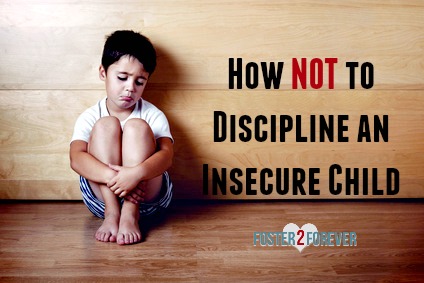
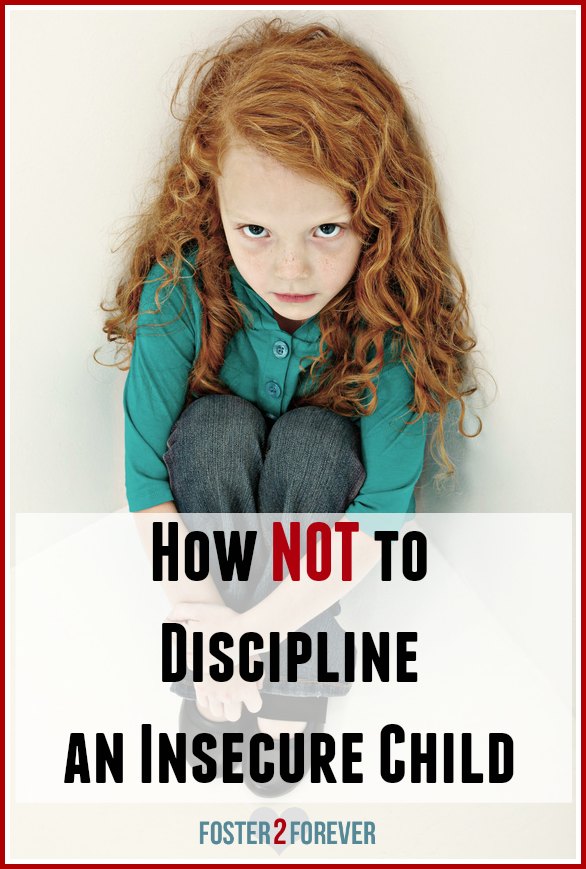
How NOT to Discipline an Insecure Child

Time-out is the most common way used today to discipline a child. And it may work for most children; however, time-out may not work if you have an insecure child. Here’s why!

how-to-discipline-a-child

How to NOT Discipline an Insecure Child

Using a time-out for discipline can trigger fear and abandonment issues, making it counterproductive, especially for insecure or at-risk children. If a child is struggling with low self-esteem, a time-out may affirm to the child that they aren’t any good.

This is particularly true with foster and adopted children that struggle with attachment because of the lack of early bonding in their lives. Because of a child’s early history of neglect and abuse, he may already feel disconnected from the family due to the lack of bonding in his earlier relationships. To these hurt children, time-out can feel like banishment and rejection from the family, which can cause the child’s mind to cycle into more insecurity. To a traumatized child, a time-out could feel like a withdrawal of love and equate to another abandonment to the child.

Through a simple time-out, a parent may be sending the message to an at-risk child: “My parents don’t want me around.” Those feelings of rejection have no outlet in a time-out which can cause turmoil inside the child. Consequently, the child may learn to withdraw from the world during times of stress instead of dealing with those emotions of disappointment.

When a child struggling with feeling insecure and controlling their emotions, that is a time in particular when a child most needs a parent’s help to wade through the turmoil.

How to Discipline an Insecure Child

You still have to discipline your child, so what do you do? Remember that there is a difference between discipline and punishment. Try disciplining your child using a time-in instead of time-out.  Using time-in to discipline your child will help your child teaches calmness, self-soothing, and thinking through emotions, plus it creates a bonding time with your child to deepen the parent-child relationship.

DOWNLOAD YOUR GUIDESHEET FOR TIME-IN DISCIPLINE

Wow I never realized how using time-out for discipline was affecting my insecure child. #parenting

1:24 pm by Penelope

Join the #RocktoberLove Challenge to Bond with your Child

Five years ago, I was struggling with parenting our demanding, hyperactive toddler we had adopted from foster care. I stumbled upon a blog post that first introduced me to the concept of attachment therapies for adoptive families.

{That blog post, The Rockin’ Mama Challenge, was written by none other than Lisa Qualls of One Thankful Mom.}

The Challenge was to sit and rock your traumatized child 15 minutes each day to promote attachment. The uninterrupted alone time between parent and child was to help give the child a pathway to learn attachment through a simple ritual of physical closeness via rocking.

Five years ago, foster parents in my neck of the woods weren’t trained much on trauma and its effects on a child’s attachment. Not many parenting strategies were doled out either, most parenting tips were “don’t spank” and “just give a time-out.”

Five years ago, I began the Challenge fighting to keep our son still and in my lap for any amount of time. A challenge it was!!!  But after a week, our son began to not resist the rocking time. After two weeks, he even asked to be rocked. As much as he fought it, my traumatized child wanted that attachment.

Five years ago, that Challenge opened my eyes to a whole new world of attachment parenting.

Join the #RocktoberLove Challenge

Rocking your child helps with attachment bond.

Now, five years later, I’d like to challenge other parents to join me in another rocking challenge during the month of October. It’s simple.

  • Join the #RocktoberLove Challenge Facebook group.
  • Rock your child for 10-15 minutes every day in October. If you miss a day, don’t give up! Just rock your child the next day! If you can’t do 10 minutes, do 5 minutes. Just rock!
  • Rock your child alone. No other children. No distractions. No books. No devices. No television. Just you and your child.
  • Keep a journal or share your experience on Instagram, Twitter or Periscope using the #RocktoberLove hashtag. Record how long, what time of day, what you did together, how your child responded, how you felt, etc.
  • Follow me on Instagram, Twitter, and Periscope.  — And others participating in the #RocktoberLove Challenge. Start a dialog. You are not alone in this!!! Here is your village.

I’ll be periscoping my #RocktoberLove Challenge experience everyday.
Will you join me?

4:07 pm by Penelope

Staying Calm During a Tantrum

I’ve written before about identifying the emotional triggers that can send a child into a tantrum – a toy doesn’t work a certain way, foods that touch each other on a plate, the word “NO”…

And when the tantrum begins, a parent is always perfectly calm, right?

I don’t know about you, but sometimes my child can certainly push my buttons, and can trigger me into my own “mommy meltdown.”

When your child throws a tantrum, make sure you dont either. Great parenting advice.

In the video below, condensed from a livestream, I discuss the importance of remaining calm when your child is misbehaving — plus I discuss the book I’m writing!!!

Video: Staying Calm During a Tantrum

Great reminder for when my child is throwing a tantrum. #parenting

  • 1
  • 2
  • 3
  • …
  • 6
  • Next Page »

Looking for something?

Facebook

Foster2Forever

Archives

Why Every Foster Parent Needs Sexual Abuse Training

foster care visitation rules guidelines online

10 Tips for Foster Care Visitation Online

foster-income-taxable

Is Foster Income Taxable? What Foster Parents Should Know About Income Tax

Why Every Foster Parent Needs Sexual Abuse Training

I’m Clever

Sway

Pretty Chic Theme By: Pretty Darn Cute Design